Showing posts sorted by relevance for query jenner. Sort by date Show all posts

Tuesday, 12 March 2013

Spying - Mark Jenner

Go to:-

http://www.bigissueinthenorth.com/2013/03/there-is-no-way-of-knowing-how-much-damage-jenner-caused/7622


‘There is no way of knowing how much damage Jenner caused’

The police spy recently revealed to be Mark Jenner worked on a number of political activists' campaigns, reveals Mark Metcalf

'There is no way of knowing how much damage Jenner caused’ - Big Issue North

https://www.bigissuenorth.com/features/2013/03/there-is-no-way-of-knowing-how-much-damage-jenner-caused/#close

Big Issue North 11 March 2013

I now know the name of the Metropolitan Police officer who was employed to spy on the protest group in which I was one of the key organisers in the 1990s. Thanks to his former partner Alison (not her real name) and the Guardian it has been established that the man I knew during my time at the Colin Roach Centre (CRC) in Hackney as Mark Cassidy is Mark Jenner of the Met’s special demonstration squad (SDS).

Jenner’s name was revealed when Alison gave evidence to the Home Affairs Select Committee inquiry into undercover policing, his police role confirmed by the Guardian on 1 March. He is one of 11 undercover police officers publicly identified. Nine of them had sexual relations with activists mainly from environmental groups.

The officers’ actions began unravelling in 2011 when the Crown Prosecution Service (CPS) dropped criminal proceedings against six people facing charges related to a conspiracy to sabotage a coal-fired power station at Ratcliffe-on-Soar, Nottinghamshire. The convictions of another 20 activists were later quashed after it was revealed that long-term police spy PC Mark Kennedy had acted as an agent provocateur within the environmental movement. Further allegations of undercover police officers acting beyond their authorisation then surfaced and we now know they were given the names of infants who had died many years previously.

The Metropolitan Police has now been ordered to investigate under Operation Herne how SDS officers created and maintained false identities while undercover.

After Kennedy became public knowledge I wrote a piece for The Big Issue in the North in January 2011 about the man I knew then as Cassidy. Although I had worked Jenner out many years beforehand it was only after he had been active in high profile campaigns in which members of CRC were involved. The centre was opened in 1993 and named after a young black man shot dead inside Stoke Newington Police Station in 1983. It combined a number of unfunded local groups, including the Hackney Community Defence Organisation (HCDA), which had uncovered serious corruption amongst the local police, with Panorama and World in Action undercover investigations confirming some officers were involved in drug dealing.

CRC was burgled, with equipment vandalised and a computer stolen. Cash was left undisturbed

HCDA’s work overturned many convictions and a database of police officers known to have complaints or convictions against them was compiled. The Defendants Information Services (DIS) was registered despite objections from the Association of Chief Police Officers. On 23 December 1994, a day when HCDA had organised a picket of Stoke Newington Police Station to demand action over the death of Oluwasijibomo Lapite in police custody, CRC was burgled, with equipment vandalised and a computer stolen. Cash was left undisturbed. An HCDA spokesperson told the Hackney Gazette: “It was the work of Special Branch, whose real target was a new database service.” In fact DIS was run from a different location.

Early the following year a Liverpudlian who identified himself as Mark Cassidy came into the centre to say he had seen TV coverage of the annual commemoration event for those who had died at the hands of the local police. The 1995 guest speaker was civil rights lawyer Gareth Pierce.“Cassidy” quickly became active in most of the centre’s political life, including writing for our internal bulletin. When a magazine sold to the public was launched his suggestion to call it RPM – revolutions per minute – was agreed. He attended members’ meetings and was privy to confidential information on hundreds of people’s policing cases, including where police officers were charged with unlawful imprisonment and conspiracy to pervert the course of justice.

Jenner was privy to confidential information on hundreds of people’s policing cases

Graham Smith, a Manchester University lecturer, consultant on police complaints to the Council of Europe Commissioner for Human Rights and an international expert on police accountability, says: “I am concerned that undercover officer Mark Jenner participated in an organisation that supported law abiding citizens who were involved in legal proceedings against the Metropolitan Police.”

CRC, with Jenner much involved, was also central to the campaign by businessman Malcolm Kennedy to prove he had not killed Patrick Quinn in 1990. Quinn had been battered to death – his injuries included 33 fractured ribs – in Hammersmith Police Station. Convicted of murder, Kennedy was released after his conviction was quashed when the World in Action programme, uncovered new witnesses in the police station, giving grounds for appeal.

At his retrial Kennedy was cleared of murder but convicted of manslaughter. After receiving the backing of 65 MPs when a parliamentary motion supporting him was tabled he was granted further leave to appeal. Kennedy lost his appeal in 1996 but as a free man he has continued to campaign to have his conviction overturned. He alleges that as a result he has suffered constant harassment by the police, making it almost impossible for him to earn a living from his removals business.

“This may have perverted the course of justice.”

Kennedy says: “I find it eerie that Jenner was involved at the CRC during the period of my 1996 appeal when he was privy to campaign strategies and confidential information. This may have perverted the course of justice. Without a proper investigation there is no way of knowing how much damage Jenner caused to me.”

Claiming to be a building worker himself, Jenner supported others victimised by their construction industry employers. The Building Workers Group (BWG) had decided to put pickets on workplaces where deaths had occurred. Three people a week were being killed on UK building sites and the aim was to damage the employers’ profits and force them to take action to prevent such tragedies. Where workers refused to cross a picket line it was maintained. However, where the majority went to work the others were persuaded to join them in order to prevent victimisation.

The initiative was a direct challenge to anti-trade union laws. Jenner attended picket lines, wrote for the BWG newspaper and came into contact with many union site representatives.

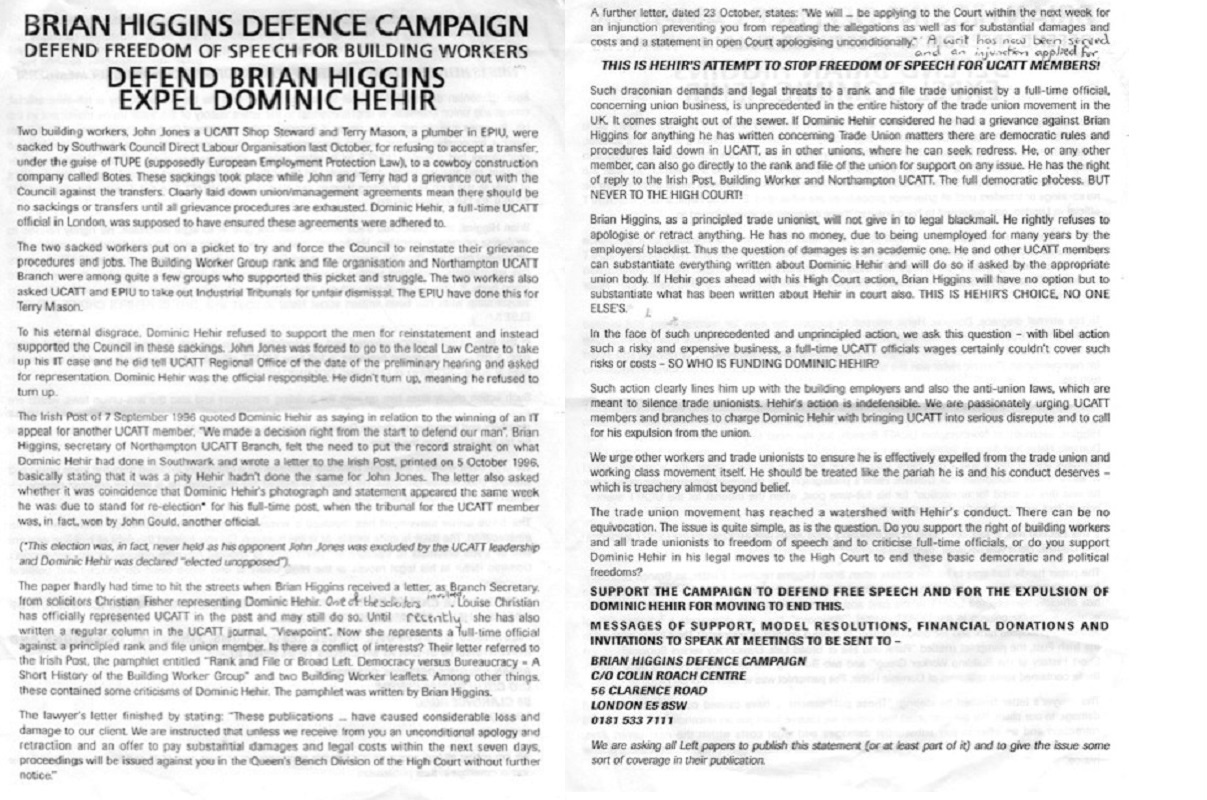
When UCATT officer Dominic Hehir sued BWG and union member Brian Higgins for libel over allegations he was failing to support members, a defence campaign was established – and Jenner became the chair. Although the campaign was successful the time taken up on Higgins’ defence meant there was little in reserve to picket sites. Those involved felt it was a hollow victory. Higgins, a blacklisted building worker, says: “I am appalled to discover ‘Mark Cassidy’ was actually an undercover police officer who used his cover as a building worker to infiltrate organisations the state does not like. It is like some Orwellian nightmare and it is surely time for decency, justice and democracy for blacklisted workers.”

Higgins is one of 3,213 building workers’ names on the Consulting Association (CA) database used by 44 building companies to vet potential new recruits over the last four decades. His file contained seven pages from RPM.

Many of those on the CA list were “not recommended for employment”. Their details were revealed after the Information Commissioner’s Office closed down CA and its owner, Ian Kerr, was found guilty in 2009 of breaching the Data Protection Act.

The Blacklist Support Group has established that some of the information supplied by CA came from the police or security services. They have lodged a formal complaint to the Investigatory Powers Tribunal – the security services watchdog – and want an investigation about the possible involvement of MI5 and other sections of the security services in blacklisting.

Spokesperson Dave Smith says: “We now want to know why an undercover cop posing as a building worker turned up on picket lines and at campaign meetings, the details of which were discovered in the CA files. Were names of building workers or any information gathered by this police officer passed on to the CA blacklist? It sure as hell looks dodgy.”

I began to ensure his information-gathering opportunities were reduced

By the middle of 1997 I had become suspicious. Jenner had failed to recognise any Tranmere fans when I watched with him the games of what was supposedly his favourite football team. On a union delegation to Ireland he walked down the fiercely Protestant Shankhill Road even though he was a Catholic. He had volunteered to take his van to Ireland, despite knowing it would result in his details being recorded by the security services.

It was all a bit odd but, unwilling to challenge him directly, I shared my concerns with those closest to me and began to ensure his information-gathering opportunities were reduced. By the end of 1997 Jenner’s involvement in the CRC had lessened. He still attended some events but mainly to report on his activities within Anti-Fascist Action (AFA), a militant group that had successfully physically confronted the BNP. AFA member Patrick Hayes had been convicted of causing two explosions in the South East on behalf of the IRA in 1993 and the state was certain to be interested in preventing any such actions in the future. Hayes was sentenced to 30 years imprisonment and later released under the Good Friday Agreement. It may be that AFA was always Jenner’s main intended target.

A concerned Alison rang his workplace, only to discover he had departed a few years previously

CRC had closed by the time Jenner disappeared from his home with Alison in April 2000. In the months beforehand he had acted suspiciously and had slept on the settee in his clothes. Alison had discovered a credit card in his real name, which he claimed to have bought for £50 to obtain petrol dishonestly.

A concerned Alison rang his workplace, only to discover he had departed a few years previously. Yet he had continued during this time to leave for work at 6.30am. Visits to a counsellor to discuss his reluctance to have children were abandoned without him mentioning his family. We now know Jenner was married.

When she discovered my reservations about Jenner, Alison contacted me in 2001 to reveal she had checked his claim that his father had been killed in a car accident in Birkenhead in 1975. The deaths register showed this tale was untrue – one more lie in a very long list.

The Home Affairs Select Committee has asked to be updated every three months on Operation Herne and Theresa May, the home secretary, has promised the Independent Police Complaints Commission will “investigate serious and sensitive allegations”. This may include some from me as I am examining the possibility that a former girlfriend who I lived with may have been in the SDS.

Smith says: “In addition to an examination of past undercover policing arrangements it is important that an independent and impartial investigation is conducted into the purpose of undercover operations. If there is evidence that undercover police officers like Jenner and his superiors were engaged in a conspiracy to pervert the course of justice, that evidence should be forwarded to the CPS, which will have to decide whether to bring criminal proceedings.”

Photo: Mark Jenner, or Cassidy, as he was known to the author and fellow activists

Like the Big Issue North on Facebook


Wednesday, 19 March 2014

Undercover but within sites

This is a slightly revised version of an article from the current edition of the Big Issue in the North magazine 

The government has just ordered an inquiry into the role of undercover police spies. Mark Metcalf, who first revealed the activities of one spy in The Big Issue in the North three years ago, reveals more about his activities and asks whether the inquiry will go far enough.

Campaigners for blacklisted building workers have called for the new public inquiry into undercover police spying to be widened to include police collusion with blacklisting. 

Two weeks ago the home secretary, Theresa May, ordered the public inquiry after two reports found that the Metropolitan Police had spied on the family of Stephen Lawrence, victim of a racist murder.

The reports – one by the Metropolitan Police and the other commissioned by May – examined the role of a police unit, the Special Demonstration Squad (SDS), in using undercover spies in the Lawrence case and in infiltrating groups of political activists, with spies in some cases conducting sexual relationships with members of the groups.

May said the findings were “deeply troubling” but the Blacklist Support Group (BSG) condemned the police report, stemming from the Operation Herne inquiry, as a whitewash because it described police discussions with blacklisting organisations as driven by “civic duty”. 

For over four decades, 44 companies paid the Consulting Association (CA) to vet 3,213 potential new recruits in the construction industry. 

Many of those listed were active trade unionists involved in raising safety concerns in an industry with the highest death rate in the UK. They were often “not recommended for employment” but for years remained unaware they had been victimised and left unable to earn a living. The CA was closed down by the Information Commissioner’s Office in 2009. 

Peter Francis, an SDS officer who claimed last year he was instructed to find information on the Lawrences, has also said that he supplied information on trade union activists to a blacklisting agency 
The Independent Police Complaints Commission has also said it is “likely that all Special Branches were involved in providing information” that resulted in many individuals being refused work by some of Britain’s biggest construction companies. 

Mark Jenner was an SDS member who posed a building worker named Mark Cassidy between 1995 and 2000. Jenner was unmasked when his partner Alison*, gave evidence to the Home Affairs Select Committee inquiry last year into undercover policing.  

Jenner met Alison when he became actively involved with the Colin Roach Centre in Hackney. This was an unfunded political centre known for its work in uncovering corruption amongst the local police. Centre members also participated in industrial disputes. This gave Jenner ample opportunity to collect information on construction workers involved in disputes. 

As an activist myself at the centre in that period, I first revealed some of Jenner’s activities in The Big Issue in the North in 2011 and later in 2013. More can now be brought to light.

In October 1995, plumber Terry Mason and bricklayer John Jones were sacked after they refused to be transferred from Southwark Direct Labour Organisation (DLO) to private contractor Botes. Jones feared that as a workplace representative he would be victimised by a company that had refused to recognise trade unions, and Mason supported his colleague. 

A picket was mounted at the DLO to persuade workers not to go into work and Jenner, like myself, was a regular on it for nearly four weeks. At one point he was brave enough to stand up to a strikebreaker on a motorbike waving a metal chain as he forced his way into work. Mason and Jones did not, however, win back their jobs, although both later won compensation for unfair dismissal. 

Jones was a member of the Building Worker Group (BWG), a rank and file body of activists within the UCATT building trade union independent of full-time officials. Jenner joined the BWG. 

In 1996, amidst a rising tally of workplace deaths, the BWG agreed to picket construction sites where workers had been killed. Members felt that only by stopping production and hitting employers in the pocket would companies ensure better safety on sites. But this was in defiance to anti-trade union laws and was opposed by building unions fearful they would face legal action by employers.

Jenner, an outgoing character who had few problems in engaging with people, was present on at least one picket, close to the Old Bailey, where he had plenty of opportunities – if he wished – to gather information on anyone involved.  He participated on a number of early morning visits to sites to sell the BWG newspaper and also attended a number of UCATT branch meetings, although he appears not to have joined the union. 


Jenner had identified himself as a building worker when he joined the Colin Roach Centre in 1995. He maintained this fiction by convincing Alison that when he left their home early each morning he was using his van to go to work. Some time after his sudden disappearance in April 2000, Alison rang the company he claimed to work for. She discovered he did not have the employment status with them that he had led her to believe and they had no contact number for him. 

In 1997, a campaign with links to the Colin Roach Centre was formed to defend BWG secretary Brian Higgins after he became the first trade unionist ever to be served with a writ for libel by an official from the same union, UCATT. Dominic Hehir’s ill-fated attempt to silence Higgins failed but had the effect of taking activists away from the picket line. 

The Brian Higgins Defence Campaign drew support from many parts of the trade union movement. As campaign secretary Mark Jenner had opportunities to collect information on trade unionists corresponding with the campaign. According to Brian Higgins, the CA file on him has a page of known associates from the 1970s and early 80s as well as a large number of articles on his case from the magazine that the Colin Roach Centre printed in the 1990s. 

In July 1999 Jenner was prominent in supporting a successful picket in support of construction workers employed by Dahl Jensen and whose pay cheques had bounced for three weeks but, despite all his union activism, his name does not appear on any of the blacklisting files seen by the BSG. 

A CA member has told the Scottish Affairs Select Committee, which examined blacklisting, that his organisation had no link to the police. A Special Branch officer also told Operation Herne that “the information was purely one way” – from the CA to the police – and that it was driven by a sense of “civic duty”. 

None of which gives a clue as to why a serving police officer would pose as a building worker. Or why he joined other building workers – who were not committing any crimes – who were struggling to improve their terms and conditions.

The BSG remains concerned at what role undercover police officers may have played in helping deny a number of building workers the chance to work and support their families. 

In a statement the organisation said: “We want a fully independent inquiry into the extent of police links with corporate spying in order to expose undemocratic shady practices. Any public inquiry should not be narrowly focused on the Lawrence case but should include officers’ sexual relationships with female activists, Hillsborough, environmental and anti-racist campaigners, blacklisting and police collusion with big business.”


* not her real name

Monday, 27 January 2014

Did police spy Mark Jenner help prevent justice in the David Ewin murder case?

When on February 1995, PC Patrick Hodgson gunned down an unarmed man, the self-funded Colin Roach Centre (*) in Hackney was approached by the dead man's wife, Sarah Ewin, to help seek justice.

See: - http://www.independent.co.uk/news/officer-shot-unarmed-suspect-1312861.html

The killer had to endure 3 trials before he was finally pronounced innocent of murder or manslaughter. The first trial was stopped in controversial circumstances when two people in the public gallery shouted out that Hodgson had known Ewin before the shooting incident and brought proceedings to a sudden end. With a re-trial costing at least a million in public funds you would have assumed that the very least that security officers in the highest court in the land, the Old Bailey, would have done was prevent those who had forced the trial to be abandoned from leaving. Not so. Surely then the Met Police would ensure they later arrested them? Not so, even though many people knew who they were.

The events were covered in the magazine produced by the Colin Roach Centre titled RPM. What follows are the articles from issues 3 and 4. In the article from number 3 the final paragraph is of particular interest as it makes reference to 'a wider State-inspired plot......probably we will never know if the two who intervened were part of something wider........'

Many years on we do know that the Colin Roach Centre/HCDA was at the centre of a wider State inspired plot as it had within its ranks Mark Jenner (see http://www.bigissueinthenorth.com/2013/03/there-is-no-way-of-knowing-how-much-damage-jenner-caused/7622) Jenner wrote a number of articles for RPM magazine (see below) and also the internal newsletter for members.

Jenner attended a number of events in support of Sarah Ewin and also attended the Old Bailey. What was his role in this and other events - such as the campaigning by Malcolm Kennedy to clear his name and demonstrate the police killed Patrick Quinn (see http://writemark.blogspot.co.uk/2013/12/malcolm-kennedy-rip.html) - in which the police were under the microscope?


* This was an unfunded radical centre that had originally opened after the council took away the funding at my workplace, the Hackney Trade Union Support Unit, and rather than see it close down it was merged with Hackney Community Defence Association [HCDA] that had been formed in 1988 to successfully oppose the criminal - including drug dealing - and brutal activities of the police. Prominent within HCDA was Celia Stubbs, the partner of Blair Peach who was killed by the police in Southall in 1979. 

Friday, 13 March 2026

Brian Higgins was known as Britain’s most blacklisted worker.

 As reproduced from some years ago. 

Brian Higgins

The late Brian Higgins was known as Britain’s most blacklisted worker.

See for example this Guardian obituary, which – deliberately so – explains very little. Brian seems like a worthy guy in it, whereas he was a fierce opponent of the capitalist system and a constant thorn in the side of those, who in all sorts of ways, make sure there is the constant, ongoing exploitation of working people across the globe. We have the quite sickening situation today where people who have written books and even made a film cannot bring themselves to take a real look at the many reasons why Brian was victimised.

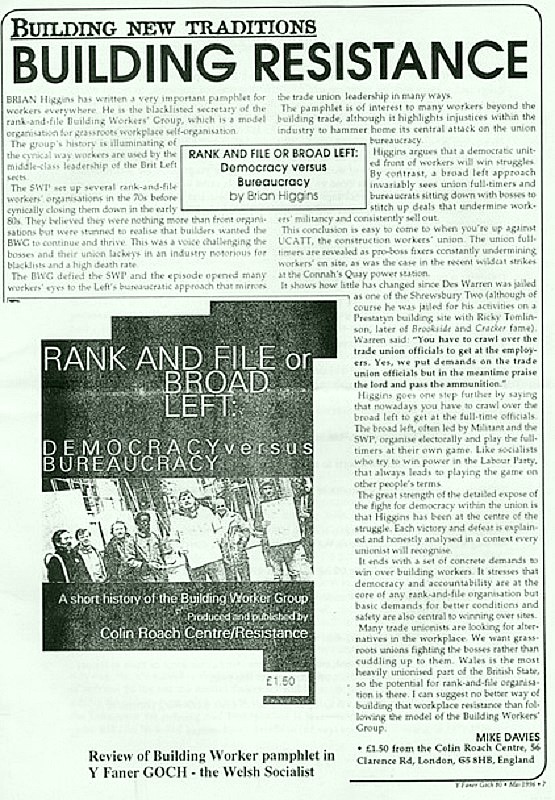
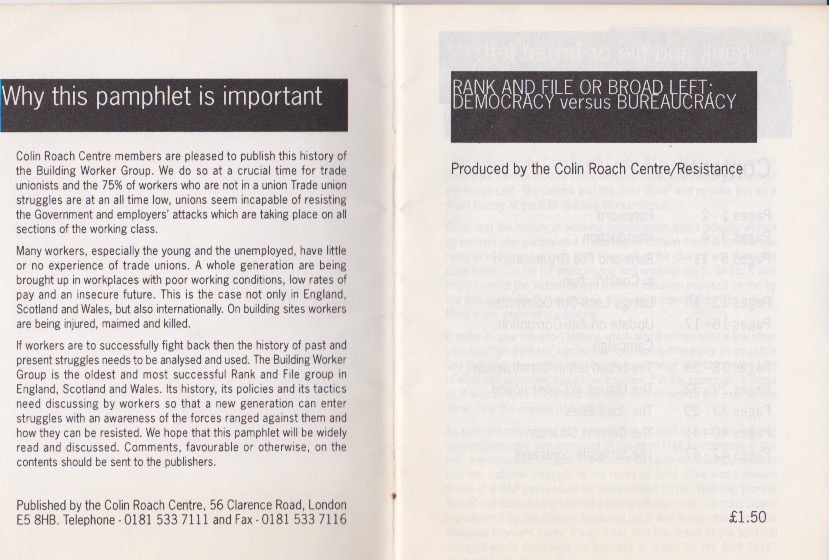
Brian’s file at the Consulting Association was the largest of any building worker on their list. Included in the information was a booklet I helped to bring out through the Colin Roach Centre (CRC) titled Rank and File or Broad Left: democracy versus bureaucracy

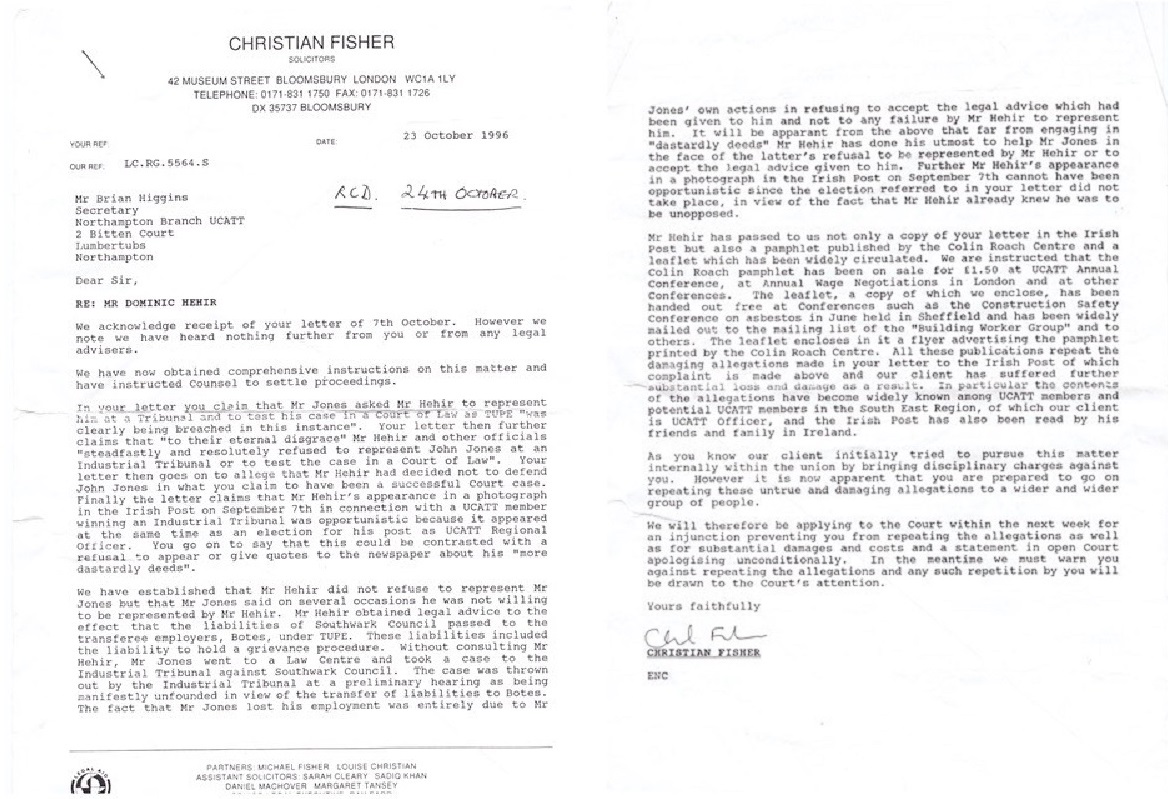
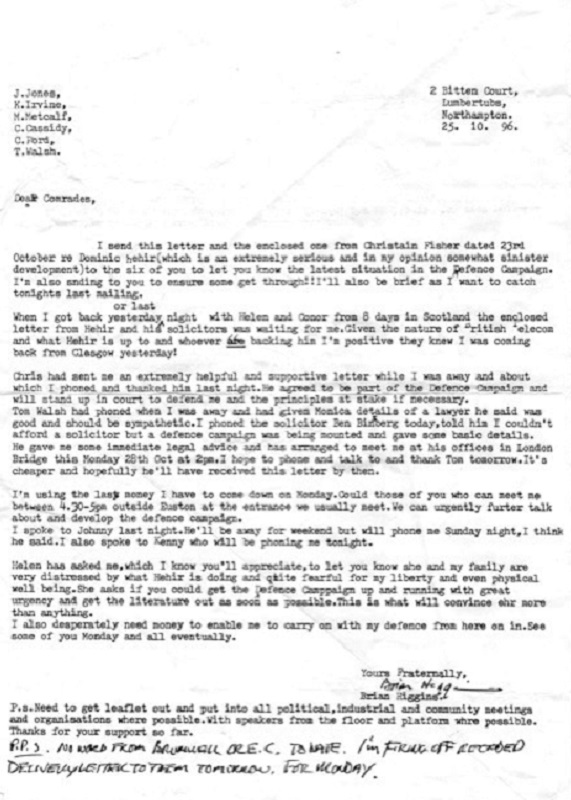
This work was also cited in an attempt by UCATT official Dominic Hehir in his attempt to sue Brian for libel. This is the only known case of a union official attempting to sue an ordinary member of a union. The attempt ultimately failed. A support group was set up to back Brian and the secretary of this group was Mark Cassidy, a member of the Colin Roach Centre, who was later found out to be Mark Jenner, a police spy. Jenner subsequently provided information on Brian and a number of other building workers to the Consulting Association.

Part of this Big Issue North article states:-

When UCATT officer Dominic Hehir sued BWG and union member Brian Higgins for libel over allegations he was failing to support members, a defence campaign was established – and Jenner became the chair. Although the campaign was successful the time taken up on Higgins’ defence meant there was little in reserve to picket sites. Those involved felt it was a hollow victory. Higgins, a blacklisted building worker, says: “I am appalled to discover ‘Mark Cassidy’ was actually an undercover police officer who used his cover as a building worker to infiltrate organisations the state does not like. It is like some Orwellian nightmare and it is surely time for decency, justice and democracy for blacklisted workers.”

Further reading: Undercover but within sites

Below are links to some of the documents in this case and about which I shall be writing more in the future. Note to book publishers – please get in touch if interested

  • Rank and File or Broad Left book
  • Article by Brian in the CRC magazine : Number 1 titled Death on the site
  • Article by Brian on the libel action in the CRC magazine : Number 2
  • Article by Brian in the CRC magazine : Number 3

See also the self published pamphlet by Des Warren – Shrewsbury: whose conspiracy? The need for an inquiry – on events during the 1972 Building Workers’ strike and which saw him later sent to prison along with Ricky Tomlinson.

You can also read the following documents:-

The 2 page letter from Louise Christian informing Brian Higgins about the libel action

Brian’s 1-page reply to the above

Brian Higgins Defence Campaign 2-page leaflet

Unpublished 2 page article sent to Workers Press

Victory – the letter by Louise Christian, civil rights solicitor (sorry hypocrite) on Hehir’s humiliating climbdown. Not one word that they lost, they proved now’t and couldn’t even be brave enough to admit it. Still, it did mean the original objective of Brian and others like myself of stopping sites when deaths occurred was lost – as time was otherwise spent on this legal attack by Hehir, who we still don’t know funded his actions.

Dominic Hehir’s infamous and ultimately unsuccessful High Court writ against Brian Higgins 

Wednesday, 11 May 2022

The spy who duped me

 The spy who duped me

Helen Steel was the publicity-shy activist who courageously and famously fought a burger giant through the courts as one of the McLibel Two. But the full story of how she and other women were deceived into relationships with undercover police spies is only now being told. By Mark Metcalf

BIG ISSUE NORTH 4 - 10 APRIL

When McLibel campaigner Helen Steel was finally able, in Sydney in 2016, to confront John Dines, the undercover police officer who tricked her into a long relationship in the early 1990s, she still retained remote hopes he might have had genuinely loving feelings for her during their time together. Perhaps he even shared some of her anti-capitalist beliefs.

“I said to him that he knew I was in a really bad state when he left and asked why did he still pretend to care for me rather than put me out of my misery and say he was never coming back,” says Steel.

“‘What did I have? All I had was a van,’ was his initial reply. When I pressed him further he responded dismissively by saying: ‘I’m sorry, I had a really shit time too. It – the whole thing – messed my head up and I just wanted to put it behind me and make a new start.’ I had this realisation that he was a completely selfish bastard and he had not cared one bit for me.”

Now the full story of this abusive relationship – and the cases of four other campaigners conned by officers of the highly secretive Metropolitan Police unit the Special Demonstration Squad (SDS) into similar relationships, all sanctioned at the highest levels of the state – is being told in a new book.

The title Deep Deception was collectively chosen by the five women. “From amongst many possibilities it best conveys our experiences. The level of deception and the discovery of it really had a serious psychological impact on everyone,” explains Steel, who has though courageously fought back. The widespread use of the officers from the SDS, formed in 1968, to undermine movements of social justice, environmental campaigns, trade unions and political organisations continues to be exposed at the ongoing Undercover Policing Inquiry (UCPI).

When Steel first met Dines in late 1987 at London Greenpeace, he claimed he was John Barker and infiltrated the environmental group after the exit of SDS officer Bob Lambert, a Greenpeace member from 1983 to 1987.

“Lambert, or Robinson as we knew him, was involved in writing the 1986 anti-McDonald’s leaflet that me and Dave Morris were sued over,” says Steel. “John was involved in the anti-McDonald’s campaign, and in the McLibel Support Campaign and our legal defence.”

The leaflet alleged that McDonald’s exploited children through its advertising, promoted unhealthy food, paid low wages, was anti-union and was responsible for animal cruelty and environmental damage. The libel campaign was the longest such case in English history and lasted over a decade. At the conclusion some of the leaflet’s contested claims were found to be libellous and others, such as McDonald’s endangering the health of workers and exploiting children, were true. The company also paid its workers poorly and inflicted unnecessary cruelty on animals.

Deep Deception reveals that Dines waited two years before asking Steel to go out with him. He had slowly been building up a relationship with Steel, a gardener, by dropping her off last in his van when he drove fellow activists home from meetings. It was a common tactic by undercover officers, including Mark Jenner, who was to have a five-year relationship with Alison, a political activist at the Colin Roach Centre in Hackney. The case of Jenner, known as Cassidy at the time, has been explored in a series of Big Issue North articles dating back to January 2011.

 “John told me in Sydney that he was tasked with reporting on everything that was going on in the North London anti-capitalist, animal rights, poll tax and environmental movements – everything that was a bit alternative. I did not go out with him until 1990. If I had known he was using me to spy on groups of people whose politics I shared then I would never have had a relationship with him,” says Steel, who now lives in the North.

As the relationship became more intense, Barker told Steel he wanted to have children. It was a con. After a period when he would mysteriously disappear for short periods, citing his mental state, the undercover cop left permanently in late 1992. Steel was distraught.

In the book she describes how in early 1993 “I felt both physically and mentally spent. John’s disappearance still consumed my thoughts every day.” Her attempts to find him floundered.

When the McLibel trial began at the Royal Courts of Justice in Central London in 1994, Steel walked each day past St Catherine’s House, which at the time held the register for all the births, deaths and marriages in England. It was a place she had visited previously when she helped look up Dines’s family records to help in what he claimed was a search for his father.

She decided to search at St Catherine’s House again and was stunned to find a death record for someone called Barker who died in 1968, matching John’s name and place of birth. “In the County of Derby, Philip John Barker: male, aged 8 years. The cause of death was acute lymphatic leukaemia.”

Steel felt a chill down her spine.

“John had been using the identity of a dead child. John Barker – the man I’d loved, the man I’d planned to spend the rest of my life with – didn’t exist. He never had… my whole world had been pulled from beneath my feet and I didn’t know who I could and couldn’t trust.”

Steel was determined to find out the truth. She travelled to New Zealand to try to find Dines, who had claimed he had lived there as a teenager and had moved there after leaving the police in 1994. Following her visit the Metropolitan Police moved him to Australia to prevent her finding out the truth, according to a police source quoted in the Guardian.

Semi-official confirmation eventually arrived in 2011 when the former partner of an undercover officer told her Dines had been one too. Around this time, it emerged that another undercover officer, Mark Kennedy, had had several relationships with environmental activists he had spied on. Deep Deception includes the cases of two women, Lisa and Naomi, both tricked by Kennedy, who was known as Mark Stone during his time undercover and collected information on environmental groups such as Earth First. Gradually, activists, journalists and the whistleblower Peter Francis, one of Dines’s former colleagues, began revealing the real story about SDS, including the use of dead children’s identities. Dines, Lambert and Jenner (the latter employed to spy on me, among others, while working as an organiser at the Colin Roach Centre) suddenly found themselves in the newspapers.

 Seeking to prevent these human rights abuses, Steel and other deceived women took legal action against the Metropolitan Police. Some of them had even had children with officers who, after faking mental breakdowns, suddenly disappeared without explanation.

All the officers had occupied important positions, such as secretary or treasurer, in campaigns that covered anti-racism, miscarriages of justice, corruption and employment rights. Such roles allowed the police to assemble information on the political activists involved. By getting together and speaking out, the deceived women destroyed claims by the police that their experiences were the result of an isolated officer. Steel says: “We knew that between the eight of us who sued the Metropolitan Police that there were at least five different officers who deceived women and that the period of relationships was nearly 25 years. There was obviously a systematic pattern of abuse, either for the officers’ own purposes or undermining protest movements.” The civil action against the police proved successful. In November 2015, the Metropolitan Police gave a full apology, conceding, as part of a settlement, that they had abused the women’s human rights. This apology has since been extended to some but not all the other people affected by relationships with undercover policing. Many women are still fighting their cases.

The exposure of undercover officers deceiving women also helped push then home secretary Theresa May to set up the UCPI. Beginning in July 2015 it was earmarked to last three years but seems unlikely to conclude before 2026 “The police are obstructing justice and are going through documents from decades back and redacting them to hide the names of those responsible for these human rights abuses,” says Steel.

“The police want it to be delayed as when the results are announced they can say what happened is historic, that things have changed and there is nothing to see here. And yet as we know the Covert Human Intelligence Sources (Criminal Conduct) Act 2021 makes provision for the use of undercover law enforcement agents and covert sources and the committing of crimes in the undertaking of their duty. The police are also still seeking to recruit informers, as shown in a recent Black Lives Matter campaign in Cardiff.”

In 2016 something made her Google John Dines. “To my surprise and, after years of finding nothing, a document popped up with his signature on the bottom. It was the first proof I’d had in over 20 years that he was still alive.” He was a course director at a police college in Sydney, training Indian police officers to tackle so-called left-wing extremism. Concerned he was using SDS tactics to abuse Indian women in a similar way, she went to track him down, confronting him at the airport where he was meeting his trainees. “You owe me an apology.”

Steel had to overcome her natural shyness to fight McDonald’s, find Dines and now fight the secret state. Why should people buy Deep Deception? “It is a good read and important for understanding the lengths the state is prepared to go to by organising a secret political policing unit in order to prevent change from happening and preserving the status quo on behalf of the rich and powerful.

“This should be deeply alarming to anybody. We could have got rid of racism, sexism and stopped the destruction of the planet long ago had there not been massive state interference by these sorts of organisations.” n Deep Deception: The Story of the Spycop Network by the Women who Uncovered the Shocking Truth is published by Ebury. Helen Steel is speaking about the book at 2pm, 10 April at the Trades Club, Hebden Bridge (free, donations welcome)

Friday, 18 March 2016

Why Mark Jenner may have spied on Colin Roach Centre? - The Hackney Community Defence peoples' account of Hackney anti-poll tax demonstration in 1990

This gives an example of the marvellous work undertaken by Hackney Community
Defence Association and perhaps gives an understanding of why Mark Jenner was
employed to spy on the organisation. 


Thursday, 27 August 2015

Mark Jenner - police spy

I contributed heavily to this excellent piece of research on police spy Mark Jenner:-

http://powerbase.info/index.php/Mark_Jenner


Friday, 18 March 2016

Rank and file or broad left booklet - is this amongst the reasons why Mark Jenner spied on the Colin Roach Centre?

Mark Jenner of the Special Demonstration Squad was secretary of the DEFEND BRIAN HIGGINS CAMPAIGN.
The Colin Roach Centre published this booklet by Brian and parts of it were cited in an unsuccessful
libel attack by a UCATT official. Parts of this booklet were also found in the blacklisting files of the Consulting Association when it was raided and closed down in 2009. Clearly the state thought it was important and it is reproduced here for anyone who is interested. It is not intended to enter into debate on the contents of the booklet itself.