Showing posts sorted by date for query jenner. Sort by relevance Show all posts

Friday, 13 March 2026

Brian Higgins was known as Britain’s most blacklisted worker.

 As reproduced from some years ago. 

Brian Higgins

The late Brian Higgins was known as Britain’s most blacklisted worker.

See for example this Guardian obituary, which – deliberately so – explains very little. Brian seems like a worthy guy in it, whereas he was a fierce opponent of the capitalist system and a constant thorn in the side of those, who in all sorts of ways, make sure there is the constant, ongoing exploitation of working people across the globe. We have the quite sickening situation today where people who have written books and even made a film cannot bring themselves to take a real look at the many reasons why Brian was victimised.

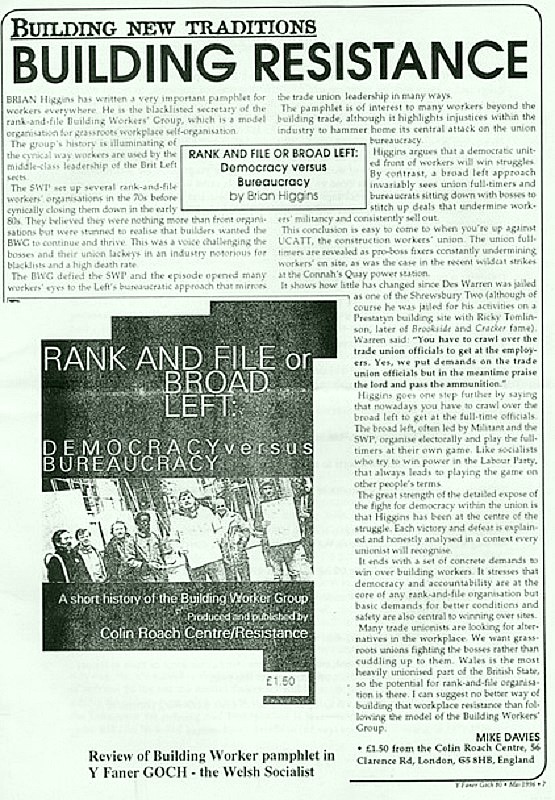
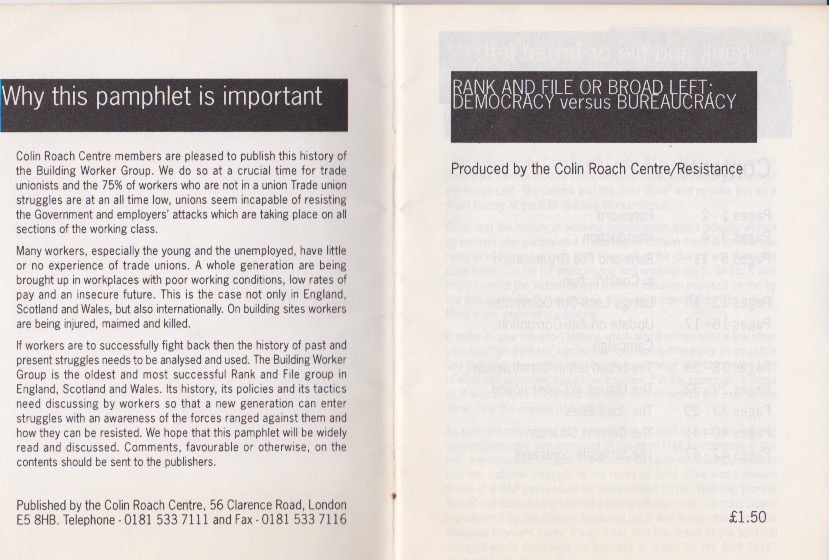
Brian’s file at the Consulting Association was the largest of any building worker on their list. Included in the information was a booklet I helped to bring out through the Colin Roach Centre (CRC) titled Rank and File or Broad Left: democracy versus bureaucracy

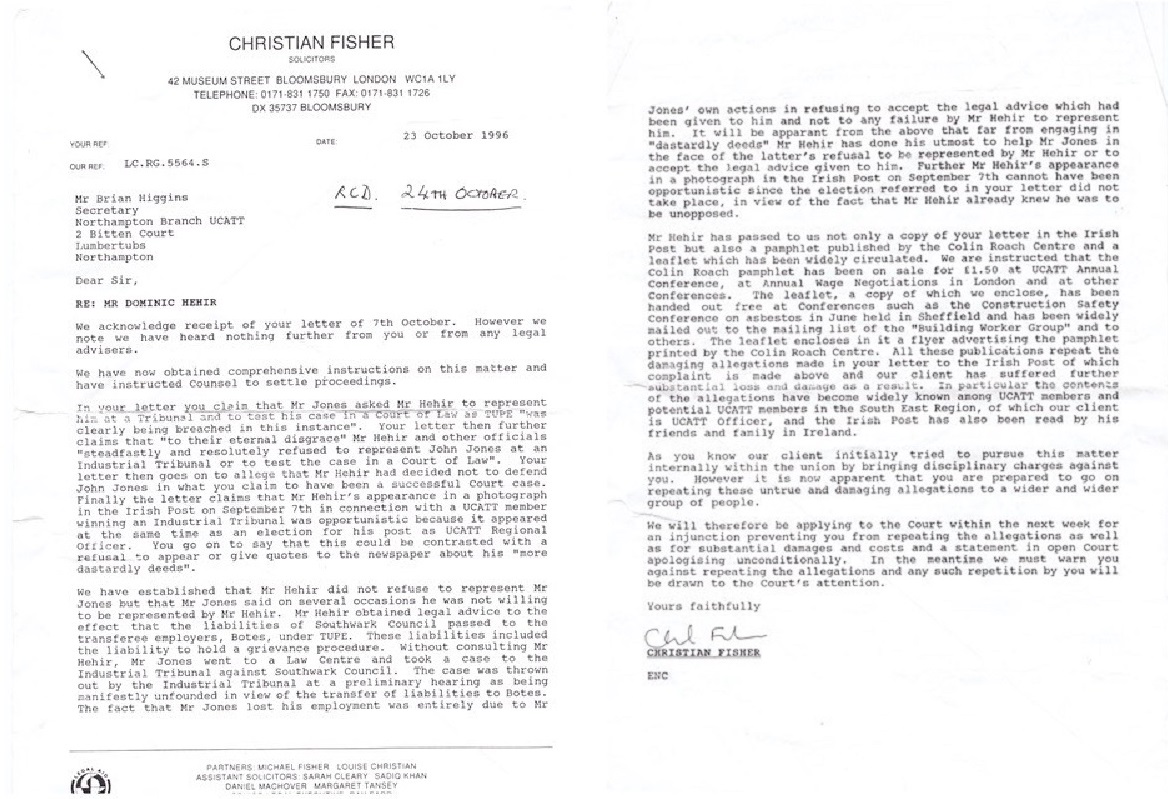
This work was also cited in an attempt by UCATT official Dominic Hehir in his attempt to sue Brian for libel. This is the only known case of a union official attempting to sue an ordinary member of a union. The attempt ultimately failed. A support group was set up to back Brian and the secretary of this group was Mark Cassidy, a member of the Colin Roach Centre, who was later found out to be Mark Jenner, a police spy. Jenner subsequently provided information on Brian and a number of other building workers to the Consulting Association.

Part of this Big Issue North article states:-

When UCATT officer Dominic Hehir sued BWG and union member Brian Higgins for libel over allegations he was failing to support members, a defence campaign was established – and Jenner became the chair. Although the campaign was successful the time taken up on Higgins’ defence meant there was little in reserve to picket sites. Those involved felt it was a hollow victory. Higgins, a blacklisted building worker, says: “I am appalled to discover ‘Mark Cassidy’ was actually an undercover police officer who used his cover as a building worker to infiltrate organisations the state does not like. It is like some Orwellian nightmare and it is surely time for decency, justice and democracy for blacklisted workers.”

Further reading: Undercover but within sites

Below are links to some of the documents in this case and about which I shall be writing more in the future. Note to book publishers – please get in touch if interested

  • Rank and File or Broad Left book
  • Article by Brian in the CRC magazine : Number 1 titled Death on the site
  • Article by Brian on the libel action in the CRC magazine : Number 2
  • Article by Brian in the CRC magazine : Number 3

See also the self published pamphlet by Des Warren – Shrewsbury: whose conspiracy? The need for an inquiry – on events during the 1972 Building Workers’ strike and which saw him later sent to prison along with Ricky Tomlinson.

You can also read the following documents:-

The 2 page letter from Louise Christian informing Brian Higgins about the libel action

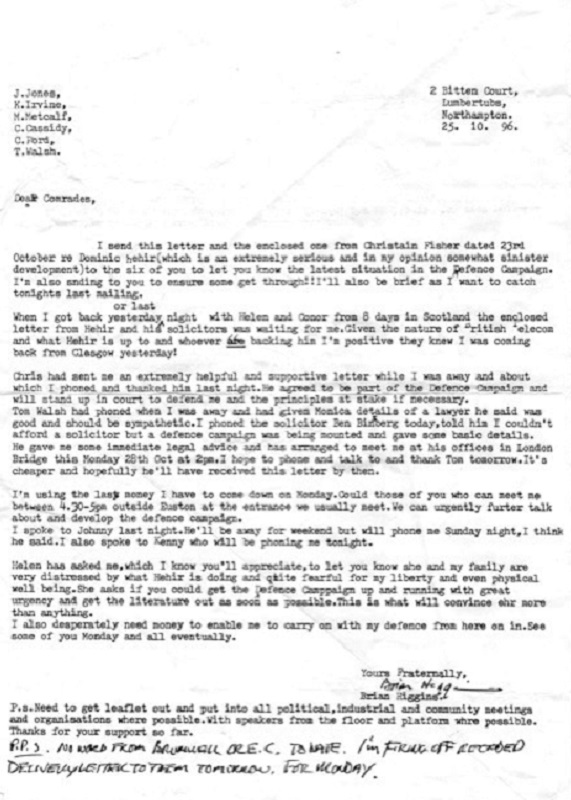
Brian’s 1-page reply to the above

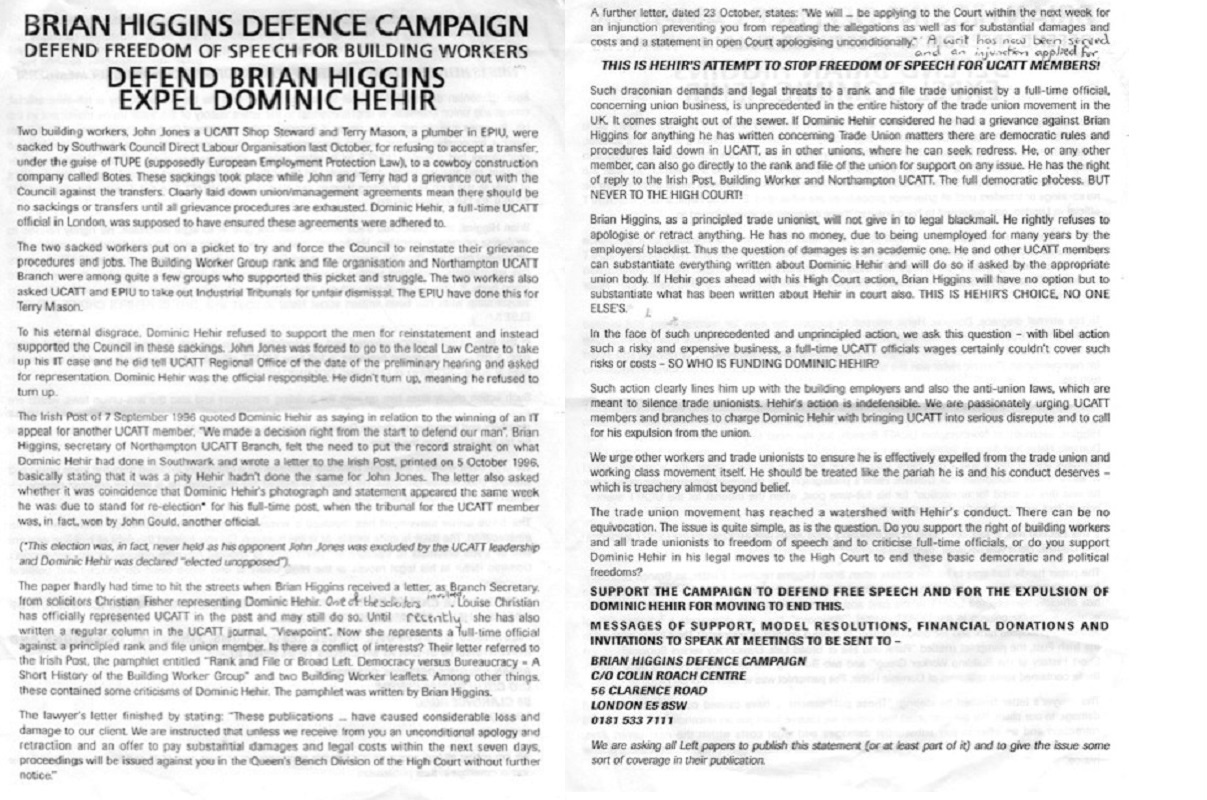
Brian Higgins Defence Campaign 2-page leaflet

Unpublished 2 page article sent to Workers Press

Victory – the letter by Louise Christian, civil rights solicitor (sorry hypocrite) on Hehir’s humiliating climbdown. Not one word that they lost, they proved now’t and couldn’t even be brave enough to admit it. Still, it did mean the original objective of Brian and others like myself of stopping sites when deaths occurred was lost – as time was otherwise spent on this legal attack by Hehir, who we still don’t know funded his actions.

Dominic Hehir’s infamous and ultimately unsuccessful High Court writ against Brian Higgins 

Friday, 31 January 2025

How Halifax CLP supported their MP in refusing to condemn state rape


When Halifax CLP backed their local MP after she refused to vote against a bill sanctioning criminal behaviour such as rape, murder and torture by public servants including spy’s.


I was a member of Halifax CLP from around 2018 to 2023 when I quit the Labour Party.


Around 2018 I had raised the issue of the ‘Spycops’ women who had been deceived by members of the London Met Special Demonstration Squad (SDS) into having relationships with them.

https://www.bigissuenorth.com/features/2022/04/the-spy-who-duped-me/


At the time, LUSH had highlighted what had been going on in a public campaign and, as to be expected in a world where most of the media can’t contemplate not supporting whatever the police do, was criticised.

https://www.elle.com/beauty/a21098901/spycop-lush-cosmetics-explainer/


The Halifax MP at this time was Holly Lynch, who was asked by myself at a CLP meeting about supporting the campaign and the policeman’s daughter replied she would not and furthermore she sought to condemn it by stating “it was inappropriate.”  


There were murmurs in the room but nobody amongst the other delegates present said anything until I said that what had happened to the Spycops women was state rape and at which point some delegates clearly felt I had gone too far.


Two years on the issue had become much more high profile especially as desperate to defend the murky actions of their agents the Tory government wanted to give them the backing of the law and had introduced legislation, known as the Covert Human Intelligences Sources (CHIS) Bill, to do so.


Now being led by security technocrat Kier Starmer, who funnily enough back in 1991 I had given short shrift to when he wanted to boost his profile by taking up on a pro bona basis cases that were being supported by the Trafalgar Square Defendants Campaign, Labour nationally was desperate not to be seen as in anyway ‘anti-police’.


Despite some considerable discontent amongst many members nationally, which did result in some MPs being willing to vote against the legislation, Starmer got his way and the vast majority of Labour MPs abstained


https://labourlist.org/2020/10/35-labour-mps-break-whip-to-oppose-spycops-bill-as-seven-frontbenchers-quit/


The Tories bill thus became the Covert Human Intelligence Sources (Criminal Conduct) Act of 2021.


In late 2020 I took the issue to my ward branch meeting and the following resolution (below) was passed and subsequently sent for debate at a Halifax CLP meeting that proved to be one of the largest in many years. It was proposed to condemn the MP for her actions.


It being in the middle of COVID the event was held on Zoom.


I spoke first in support of the motion and following which Holly Lynch spoke. Other delegates spoke afterwards including several who were very supportive of my raising of the issue but who all subsequently abstained on the motion which was eventually defeated by 33 votes against 4 in favour.


Resolution


The Warley ward of HALIFAX CLP unreservedly condemns the action of our elected Labour MP, Holly Lynch, for her refusal to vote against the Covert Human Intelligences Sources (CHIS) Bill, known as the Spycops Bill, which will allow undercover agents to break the law and engage in rape, murder and torture in the name of national security.  


The British state has a long history with undercover agents operating without much scrutiny, interfering in and devastating the lives of innocent people including dozens of women who were deceived by members of the London Met Special Demonstration Squad (SDS) into having relationships with them. The family of Stephen Lawrence was also targeted by police spies.


These and many other similar cases and organisations, totalling over 1,000 political groups, are now being examined at a long running public inquiry, which has already been severely restricted by the shredding of numerous documents by one of the secret intelligence units when the inquiry was first announced. Warley Ward member Mark Metcalf was for many years spied upon for exposing police corruption and also seeking to improve pay and conditions for workers by the SDS’s Mark Jenner. Mark Metcalf is a Core Participant at the said inquiry. The CHIS bill is clearly aimed at undermining the long-fought campaign to force an inquiry into abuses by police spies.


This ward notes that by abstaining in Parliament when the Bill was voted upon that Ms. Lynch joined a large number of similarly cowardly Labour MPs who sought to argue that the security services must have the powers needed to keep us safe and that other countries such as Canada have similar legislation in place. Yet clearly giving the state powers to murder, torture and rape people is not the best way to keep us safe and other similar legislation internationally explicitly prohibits murder, sexual violence and other serious crimes.


Proposed by Mark Metcalf


Friday, 31 March 2023

SPY COPS VICTIM SPEAKS AT INQUIRY


 Another Big Issue North article, 27th March to 2nd April 2023 

I am due to appear as a witness at the UCPI late next year. I am available to speak at trade union and labour movement meetings about this as long as my expenses are covered. 

SPY COPS VICTIM SPEAKS AT INQUIRY

Celia Stubbs believes police spied on her to “conceal the true circumstances” of

Blair Peach’s death

She was spied on after partner killed by police

Following her appearance at the Undercover Policing Inquiry, Celia Stubbs, whose partner Blair Peach was killed by police, is convinced the police officers who spied on her did so “to help collude and conspire to conceal the true circumstances of Blair’s death and to enable the police to escape accountability for it”.

Meanwhile, Manchester University law lecturer Graham Smith, who has supported Stubbs throughout, believes there is a case for a charge of perversion of the course of justice against some senior police officers who knew the police had killed Peach but failed to prevent Stubbs being spied on.

The inquiry, led by Sir John Mitting, is scrutinising the conduct of 139 undercover officers in the Special Demonstration Squad (SDS) who spied on more than 1,000 political groups between 1968 and 2010, possibly longer. The inquiry opened in 2020 and to date has taken evidence from the period 1968 to 1982.

Fatal blow

Senior Scotland Yard officers supervised the SDS and their actions will be examined shortly.

According to David Barr KC, the inquiry’s most senior barrister:

“Senior police officers visited the SDS, were aware of its existence and, in broad terms, how it operated.” Yet none appear to “have considered whether the level of intrusion occasioned by SDS long term deployments was justified”.

In April 1979, Peach, Stubbs and friends went to Southall to protest against a National Front general election rally.

Some 3,000 Metropolitan Police officers were charged with maintaining the peace. But when they began removing 3,000 sit-down protestors, the atmosphere became ugly and missiles were thrown.

Among the police were members of the Special Patrol Group, which had gained notoriety following the Red Lion Square disorders in 1974 when student Kevin Gately was killed by a blow to the head by an unidentified assailant.

Peach was leaving Southall when, according to 14 eye-witnesses, an SPG officer struck him on the head.

He died the following day. The Metropolitan Police’s complaints bureau investigated, taking statements from SPG members, some of whose lockers contained unauthorised weapons.

Meanwhile, the police had started to spy on Stubbs. Over the decades eight officers filed reports on her.

She knows the name of only one, Mark Jenner, who did so from 1995 till around 1999.

SDS was established in 1968 with the approval of the Wilson government. Its work was to gather intelligence to prevent public disorder, and to assist the security service in defending the UK from espionage and sabotage.

SDS reported on Stubbs attending numerous meetings, including ones where Peach was not even mentioned, protests and social gatherings. Stubbs helped form Inquest, which provides expertise on state-related deaths. At none of the reported events on Stubbs was there social disorder.

“The reason for spying was to collude and conspire to conceal the true circumstances of Blair’s death and to help the police evade accountability,” said Stubbs. “It had nothing to do with public disorder.

“The inquiry has shown that the police saw accountability and justice as threatening but justice campaigns exist to uncover the truth and injustice.

The police complaints bureau report was finally released in 2010.

“It stated what we always believed – the fatal blow was struck by a Unit 1 SPG officer. It is likely it was the first officer from the van,” said Stubbs. “Deliberate untruths told by officers were laid bare. They were a major factor why nobody was prosecuted for Blair’s death.”

Smith said it was “particularly disturbing” that Stubbs was targeted when senior Metropolitan Police officers would have known that Peach was killed by a police officer, and she was spied upon for

lawfully trying to call officers to account. “By allowing this unlawful interference with her right to know what happened to her partner, the evidence disclosed to the Undercover Police Inquiry points to the existence of a conspiracy to pervert the course of justice by Met officers,” he said.

Stubbs found her inquiry appearances “traumatic.” She wants a police apology and Mitting, who lacks powers to grant one, appears sympathetic. According to Stubbs’ solicitor Simon Creighton of Bhatt Murphy: “She has shown great perseverance and thus revealed that undercover policing against justice campaigns was not about public disorder but about defending the police’s interests.”

MARK METCALF

Wednesday, 11 May 2022

The spy who duped me

 The spy who duped me

Helen Steel was the publicity-shy activist who courageously and famously fought a burger giant through the courts as one of the McLibel Two. But the full story of how she and other women were deceived into relationships with undercover police spies is only now being told. By Mark Metcalf

BIG ISSUE NORTH 4 - 10 APRIL

When McLibel campaigner Helen Steel was finally able, in Sydney in 2016, to confront John Dines, the undercover police officer who tricked her into a long relationship in the early 1990s, she still retained remote hopes he might have had genuinely loving feelings for her during their time together. Perhaps he even shared some of her anti-capitalist beliefs.

“I said to him that he knew I was in a really bad state when he left and asked why did he still pretend to care for me rather than put me out of my misery and say he was never coming back,” says Steel.

“‘What did I have? All I had was a van,’ was his initial reply. When I pressed him further he responded dismissively by saying: ‘I’m sorry, I had a really shit time too. It – the whole thing – messed my head up and I just wanted to put it behind me and make a new start.’ I had this realisation that he was a completely selfish bastard and he had not cared one bit for me.”

Now the full story of this abusive relationship – and the cases of four other campaigners conned by officers of the highly secretive Metropolitan Police unit the Special Demonstration Squad (SDS) into similar relationships, all sanctioned at the highest levels of the state – is being told in a new book.

The title Deep Deception was collectively chosen by the five women. “From amongst many possibilities it best conveys our experiences. The level of deception and the discovery of it really had a serious psychological impact on everyone,” explains Steel, who has though courageously fought back. The widespread use of the officers from the SDS, formed in 1968, to undermine movements of social justice, environmental campaigns, trade unions and political organisations continues to be exposed at the ongoing Undercover Policing Inquiry (UCPI).

When Steel first met Dines in late 1987 at London Greenpeace, he claimed he was John Barker and infiltrated the environmental group after the exit of SDS officer Bob Lambert, a Greenpeace member from 1983 to 1987.

“Lambert, or Robinson as we knew him, was involved in writing the 1986 anti-McDonald’s leaflet that me and Dave Morris were sued over,” says Steel. “John was involved in the anti-McDonald’s campaign, and in the McLibel Support Campaign and our legal defence.”

The leaflet alleged that McDonald’s exploited children through its advertising, promoted unhealthy food, paid low wages, was anti-union and was responsible for animal cruelty and environmental damage. The libel campaign was the longest such case in English history and lasted over a decade. At the conclusion some of the leaflet’s contested claims were found to be libellous and others, such as McDonald’s endangering the health of workers and exploiting children, were true. The company also paid its workers poorly and inflicted unnecessary cruelty on animals.

Deep Deception reveals that Dines waited two years before asking Steel to go out with him. He had slowly been building up a relationship with Steel, a gardener, by dropping her off last in his van when he drove fellow activists home from meetings. It was a common tactic by undercover officers, including Mark Jenner, who was to have a five-year relationship with Alison, a political activist at the Colin Roach Centre in Hackney. The case of Jenner, known as Cassidy at the time, has been explored in a series of Big Issue North articles dating back to January 2011.

 “John told me in Sydney that he was tasked with reporting on everything that was going on in the North London anti-capitalist, animal rights, poll tax and environmental movements – everything that was a bit alternative. I did not go out with him until 1990. If I had known he was using me to spy on groups of people whose politics I shared then I would never have had a relationship with him,” says Steel, who now lives in the North.

As the relationship became more intense, Barker told Steel he wanted to have children. It was a con. After a period when he would mysteriously disappear for short periods, citing his mental state, the undercover cop left permanently in late 1992. Steel was distraught.

In the book she describes how in early 1993 “I felt both physically and mentally spent. John’s disappearance still consumed my thoughts every day.” Her attempts to find him floundered.

When the McLibel trial began at the Royal Courts of Justice in Central London in 1994, Steel walked each day past St Catherine’s House, which at the time held the register for all the births, deaths and marriages in England. It was a place she had visited previously when she helped look up Dines’s family records to help in what he claimed was a search for his father.

She decided to search at St Catherine’s House again and was stunned to find a death record for someone called Barker who died in 1968, matching John’s name and place of birth. “In the County of Derby, Philip John Barker: male, aged 8 years. The cause of death was acute lymphatic leukaemia.”

Steel felt a chill down her spine.

“John had been using the identity of a dead child. John Barker – the man I’d loved, the man I’d planned to spend the rest of my life with – didn’t exist. He never had… my whole world had been pulled from beneath my feet and I didn’t know who I could and couldn’t trust.”

Steel was determined to find out the truth. She travelled to New Zealand to try to find Dines, who had claimed he had lived there as a teenager and had moved there after leaving the police in 1994. Following her visit the Metropolitan Police moved him to Australia to prevent her finding out the truth, according to a police source quoted in the Guardian.

Semi-official confirmation eventually arrived in 2011 when the former partner of an undercover officer told her Dines had been one too. Around this time, it emerged that another undercover officer, Mark Kennedy, had had several relationships with environmental activists he had spied on. Deep Deception includes the cases of two women, Lisa and Naomi, both tricked by Kennedy, who was known as Mark Stone during his time undercover and collected information on environmental groups such as Earth First. Gradually, activists, journalists and the whistleblower Peter Francis, one of Dines’s former colleagues, began revealing the real story about SDS, including the use of dead children’s identities. Dines, Lambert and Jenner (the latter employed to spy on me, among others, while working as an organiser at the Colin Roach Centre) suddenly found themselves in the newspapers.

 Seeking to prevent these human rights abuses, Steel and other deceived women took legal action against the Metropolitan Police. Some of them had even had children with officers who, after faking mental breakdowns, suddenly disappeared without explanation.

All the officers had occupied important positions, such as secretary or treasurer, in campaigns that covered anti-racism, miscarriages of justice, corruption and employment rights. Such roles allowed the police to assemble information on the political activists involved. By getting together and speaking out, the deceived women destroyed claims by the police that their experiences were the result of an isolated officer. Steel says: “We knew that between the eight of us who sued the Metropolitan Police that there were at least five different officers who deceived women and that the period of relationships was nearly 25 years. There was obviously a systematic pattern of abuse, either for the officers’ own purposes or undermining protest movements.” The civil action against the police proved successful. In November 2015, the Metropolitan Police gave a full apology, conceding, as part of a settlement, that they had abused the women’s human rights. This apology has since been extended to some but not all the other people affected by relationships with undercover policing. Many women are still fighting their cases.

The exposure of undercover officers deceiving women also helped push then home secretary Theresa May to set up the UCPI. Beginning in July 2015 it was earmarked to last three years but seems unlikely to conclude before 2026 “The police are obstructing justice and are going through documents from decades back and redacting them to hide the names of those responsible for these human rights abuses,” says Steel.

“The police want it to be delayed as when the results are announced they can say what happened is historic, that things have changed and there is nothing to see here. And yet as we know the Covert Human Intelligence Sources (Criminal Conduct) Act 2021 makes provision for the use of undercover law enforcement agents and covert sources and the committing of crimes in the undertaking of their duty. The police are also still seeking to recruit informers, as shown in a recent Black Lives Matter campaign in Cardiff.”

In 2016 something made her Google John Dines. “To my surprise and, after years of finding nothing, a document popped up with his signature on the bottom. It was the first proof I’d had in over 20 years that he was still alive.” He was a course director at a police college in Sydney, training Indian police officers to tackle so-called left-wing extremism. Concerned he was using SDS tactics to abuse Indian women in a similar way, she went to track him down, confronting him at the airport where he was meeting his trainees. “You owe me an apology.”

Steel had to overcome her natural shyness to fight McDonald’s, find Dines and now fight the secret state. Why should people buy Deep Deception? “It is a good read and important for understanding the lengths the state is prepared to go to by organising a secret political policing unit in order to prevent change from happening and preserving the status quo on behalf of the rich and powerful.

“This should be deeply alarming to anybody. We could have got rid of racism, sexism and stopped the destruction of the planet long ago had there not been massive state interference by these sorts of organisations.” n Deep Deception: The Story of the Spycop Network by the Women who Uncovered the Shocking Truth is published by Ebury. Helen Steel is speaking about the book at 2pm, 10 April at the Trades Club, Hebden Bridge (free, donations welcome)
Saturday, 20 March 2021

Core values - a core participant at the undercover policing inquiry is aiming to understand why she was targeted


Core values

A core participant at the undercover policing inquiry is aiming to understand why she was targeted


https://www.bigissuenorth.com/features/2021/03/celia-stubbs-core-values/


Celia Stubbs, whose partner Blair Peach was killed by police 42 years ago, hopes her appearance at the Undercover Policing Inquiry will help her discover why she was spied upon for decades.


Stubbs, 81, and still active politically by supporting refugees and asylum seekers, is among tens of thousands of political activists that members of the London Metropolitan Police’s Special Demonstration Squad (SDS) highlighted for attention from 1968 onwards. Targets included women, with whom officers sometimes had relationships and children.
 

Stubbs believes there can be no justification for her being spied upon by eight SDS members. She knows the proper name of one, Mark Jenner, originally from Birkenhead, who took the cover name of Mark Cassidy. She knew him when he joined a group in Hackney that supported victims of police brutality and criminality.


On 23 April 1979, Peach, Stubbs and friends went to Southall to protest against a public rally at the Town Hall by the National Front in the lead-up to the general election when Margaret Thatcher came to power. Southall residents, including many Asians, intended holding a peaceful protest. Ealing Borough Council, which had given permission for the National Front meeting to go ahead, then ignored a petition of 10,000 residents calling for it to be cancelled.


The National Front held its rallies in towns such as Blackburn, Leicester and Bradford where there was a large Asian community and similarly, the Southall meeting was a “deliberate provocation” said Stubbs.


Some 3,000 MP officers, including 94 on horseback, were charged with maintaining the peace. But when they began removing 3,000 sit-down protestors, the atmosphere became ugly, with some members of the crowd throwing missiles.


When the National Front meeting began, members of the Special Patrol Group were among police who tried to clear the area of demonstrators. The SPG was a specialist group that had gained notoriety following the Red Lion square disorders in 1974 at which student Kevin Gately was killed by a blow to the head by an unidentified assailant. According to the Stubbs: “The SPG had a reputation for clearing demonstrations by employing excessive force.”


Peach was heading out of the area when six officers from SPG Unit 1 got out of their van at the corner of Beachcroft and Orchard avenues. They were led by Inspector Alan Murray.


The officers were using riot shields and had their truncheons drawn. According to 14 eye-witnesses who gave evidence to the subsequent inquest, one of the officers struck Peach, a teacher, on the head. He died the following day.


Commander John Cass of the Metropolitan Police’s Complaints Bureau began an investigation that including taking statements from SPG members. Cass interviewed more than 400 people. A search of SPG officers’ lockers found numerous weapons that were unauthorised.


“At the inquest, which we wanted to be held in front of a jury, we requested a copy of the Cass Report but the judge was very hostile, especially to Asian witnesses. This was refused and a verdict of misadventure was given when we wanted one of unlawful killing,” said Stubbs, who began long-term campaigning to establish the truth and gain justice for her partner.


In 2010, the Cass Report was released. “It states what we always believed – the fatal blow was struck by a police officer from Unit 1 of the Special Patrol Group based at Barnes police station, and it is likely that it was the first officer out of the police van,” said Stubbs. “Deliberate untruths told by officers obstructing the police inquiry were laid bare. The deceit and lies these officers told is a major factor as to why no policeman was prosecuted for Blair's death.”


There remains no prosecution. Murray has denied he struck the fatal blow.

In the late 1980s and 1990s, Stubbs, a social worker in Islington who worked closely “with dedicated police officers” in protecting children from abuse, was a member of Hackney Community Defence Association/Colin Roach Centre (CRC). The organisation successfully supported local residents who suffered violence at the hands of the police and also exposed, thanks to World in Action and Panorama investigations, criminal activity such as drug dealing by the police. It also helped Sarah Ewin, whose husband David was shot dead in February 1995 by PC Patrick Hodgson, who became the first police officer to be charged with murder for an offence allegedly committed while on duty. He was acquitted on the third occasion.


In 1995, Cassidy, real name Jenner, joined the CRC and Stubbs met him often at meetings and events. It has subsequently been confirmed that Cassidy was a SDS member. When he disappeared in 2000, he left behind Alison (not her real name), who had assumed she was his long-term partner.


Thanks largely to Alison and other women in similar situations, Theresa May, then home secretary, ordered in 2015 a public inquiry into undercover policing, who spied on thousands of people, including the parents of the murdered teenager Stephen Lawrence. This inquiry, which the police have sought to have held behind closed doors, has progressed slowly. Stubbs will be a witness next month.


“I was really shocked and angry when I was informed three years ago that the police had a file stretching over 20 years on me and I could to apply for core participant status (CP) at the inquiry,” said Stubbs. “Eight officers filed reports but I don’t know who seven are.


“There is no justification.  It must be because of my relationship to Blair. It ties in with the bigger cover-up from the inquest when we were not allowed to see the Cass Report.


“If we had, then I feel the only inquest verdict possible was unlawful killing, leading to prosecutions. You could say it was a state killing,” states Stubbs.


She attended part of the first stage of the Inquiry in November last year and believes there are parallels with the inquest into Peach’s death back in 1980.


“Sir John Mitting, the inquiry chair, was quite hostile to non-state core participants and their barristers, refusing a request to ask three questions of police officers, some of whom appeared to have memory blanks, and allowing just one question. It felt that core participants were on trial rather than being witnesses who are overwhelmingly victims in this situation.”


Despite these concerns Stubbs hopes to “hear why they kept records on me and what they did with this information. I can only do that if I appear as a witness. I also feel there should be an attempt to hold the SDS as a whole accountable.”


The author of this article himself has core participants status at the inquiry

Friday, 18 March 2016

Why Mark Jenner may have spied on Colin Roach Centre? - The Hackney Community Defence peoples' account of Hackney anti-poll tax demonstration in 1990

This gives an example of the marvellous work undertaken by Hackney Community
Defence Association and perhaps gives an understanding of why Mark Jenner was
employed to spy on the organisation. 


Rank and file or broad left booklet - is this amongst the reasons why Mark Jenner spied on the Colin Roach Centre?

Mark Jenner of the Special Demonstration Squad was secretary of the DEFEND BRIAN HIGGINS CAMPAIGN.
The Colin Roach Centre published this booklet by Brian and parts of it were cited in an unsuccessful
libel attack by a UCATT official. Parts of this booklet were also found in the blacklisting files of the Consulting Association when it was raided and closed down in 2009. Clearly the state thought it was important and it is reproduced here for anyone who is interested. It is not intended to enter into debate on the contents of the booklet itself.