Friday, 13 March 2026

40 years since the last serious defiance of the anti-union laws.


The Laings Lock Out Committee of 1985-86 marked the last serious defiance of the anti-union laws. It was led by Brian Higgins of the Building Worker Group.

Undoubtedly the most important and significant struggle led by the Building Worker (BW) group and worth a separate mention was the 'Laings Lock Out Committee' of 1985-86 where our cumulative and collective experience was most thoroughly and seriously put to the test.

Our bricklaying gang, all BW supporters, was sacked by sub-contractors Jonoroy on a site in Surbiton in October 1985 on the instructions of Laing Homes, who were quite openly and blatantly operating the blacklist against us.

We went into immediate struggle. With our very limited numbers and resources it was obvious we would have to fight a guerrilla, hold the site we were on and hit and run, war with Laing and the Building Employers Confederation. We sought and got support from many industrial and political sources.

We formed the 'Laings Lock Out Committee'. We were so successful in our use of the flying picket tactic that we halted or severely restricted production on 8 sites in London. In all, we picketed 14 different sites. The outcome of this was Jonoroy (Laings actually) offered work on a Galliford site in Banstead in Surrey, ostensibly until the site in Surbiton was ready, or so we were told. We knew the employers would come back at us in the very short term. We had to put a picket on the Galliford job to get on it. We had to threaten a strike after we got on it to ensure they took on a hod carrier who was with us, but hadn't been at the beginning of the Lock Out.

They told us to go back to Surbiton, as that site was ready. We went to Surbiton. We were told "there's no way Higgins and the others would work on a Laing site". Our picketing was restarted and stepped up. We hit the British Library and Hays Wharf among others. The employers were shitting themselves.

They took out a high court injunction against us that threatened us with two years in jail and fines of many hundreds of thousands of pounds if we did not stop picketing, meeting and even speaking about the Lock Out. The injunction was issued in February 1986.

We took a decision in line with official TUC, UCATT and TGWU policy at that time (though they always supported the anti-union laws in practice) and much more to the point in defence of the basic freedoms of the right to speak, meet and picket, to defy the injunction and carry on. We stepped up picketing, meeting and speaking.

In the months before the injunction was issued we had visited many workplaces, and rank and file trade union organisations, and had addressed many mass meetings. So much groundwork had been done and many workers knew of and supported our struggle against the blacklist. However when the high court injunction was issued on the basis of the 1982 anti-union laws, the main issue then became the overt political one of the anti-union laws themselves. Thus, we stepped up our campaign on this basis and got a tremendous response from workplace after workplace, mass meeting after mass meeting. We had always gone and continued to go straight to the rank and file. To hell and the High Court with the bureaucracy!!

{Text of the injunction:-

1986 L. No. 443
IN THE HIGH COURT OF JUSTICE
QUEEN'S BENCH DIVISION

B E T W E E N:

LAING HOMES LIMITED First Plaintiffs

JOHN LAING SERVICES LIMITED Second Plaintiffs

LAING MANAGEMENT CONTRACTING
LIMITED Third Plaintiffs

SOUTHERN BRICKLAYING LIMITED Fourth Plaintiffs

JOHN LAING PLC Fifth Plaintiffs

JOHN LAING CONSTRUCTION LIMITED Sixth Plaintiffs
- and -

BRIAN HIGGINS First Defendant

THOMAS WALSH Second Defendant

DAVID LAVERY Third Defendant

RAYMOND MILLS Fourth Defendant

DAVID WILLIAMS Fifth Defendant

****************** Sixth Defendant

end of text}

An example of the kind of enthusiastic support we received was when I addressed a meeting of about 1,000 Islington DLO workers. Among them were bin men. They told us if we were put in jail (Pentonville was traditionally where they put 'political' prisoners in London, arising out of industrial disputes) then they would blockade Pentonville Road with their lorries until our release, as they had done for the 'Pentonville Dockers'. I addressed a meeting of 4,000 print workers. Again, there was tremendous support for our struggle against the anti-union laws. It was the same everywhere.

Needless to say this sort of support and the promise of political strike action by many thousands of workers, if we were jailed, gave us great inspiration and enabled us to carry on our struggle. No doubt, it gave the government and the High Court the opposite! We went to see the UCATT Executive Council and general secretary, A Williams at that time, and asked for their support, just for the record. Naturally they didn't give it to us but instead told us to give up our struggle. I told them they were a bunch of spineless, cringing, crawling, backstabbing bastards and we were now in open defiance of them and the High Court. George Henderson, General Secretary of the TGWU construction section, and those other spineless bastards at Tooley Street (TGWU construction section London Headquarters) took the same approach as the UCATT Executive Council. Surprise, surprise.

During the dispute I received open death threats from the employers - twice during official negotiations. It really is a nice industry to organise in! They were told there would be no more Crouches (see earlier) and that if any of us or our families were harmed then the main employer Laing and its directors would be held physically and personally responsible and we would be avenged. No equivocation!

I was also banned by a court from the Tooley Street area of London [Laing had a massive job at Hay's Wharf there which we were picketing] for a period of time during the 'Lock Out'. I managed to circumvent this on occasion but was arrested once and held in jail, overnight and just happened to miss an employer/union conciliation panel which took place the next morning!!

For two months we openly and successfully defied the High Court and the anti-union laws, a tremendous political victory which has immediate implications for today's struggles. However on the industrial front A Williams, the UCATT general secretary, in secret negotiations signed a document with the employers' national secretary which removed all official recognition from our dispute be it at Surbiton or anywhere else. We didn't have enough building workers involved to force a negotiated settlement outside of the official machinery, which is what it would have taken, and after six months of tremendously hard struggle we called off our struggle against the blacklist with the knowledge it will have to be fought another day. Hopefully not far off now.

However, we set London alight for six months and exposed the gangster system of employment in the industry. We gave hope to many building workers; we proved the anti-union laws and High Court could be successfully defied! We exposed the full corrupt depth to which P Kavanagh, the London regional secretary of the TGWU (Tooley Street), had sunk and forced the TGWU to sack him. Unfortunately, he is only the tip of a very huge corrupt official iceberg.

The Federation of Brick Contractors was formed as a result of our struggle; meaning the brutalisation of a physical nature would lessen but they would now, and do, court official union support and corrupt it horribly in the process to counter any repeat of the 'Laings Lock Out' type of action. Before and since the blacklist has kept quite a few of us off the sites. Some have been so demoralised with this, and the state of the unions and the left, that they have given up the struggle.

But there were enough of us left to continue the struggle and how. Shortly after the Laings Lock Out in 1986 we were involved in supporting workers on a McCarthy Stone site in Sutton in Surrey. I was arrested on the picket by Special Branch, taken to the local jail and told if I didn't leave the area and stay away I'd spend a very long time on remand in Brixton Jail! To our knowledge this was unprecedented in an industrial dispute and shows the threat we posed after successfully defying the High Court and the anti union laws!

Brian Higgins was known as Britain’s most blacklisted worker.

 As reproduced from some years ago. 

Brian Higgins

The late Brian Higgins was known as Britain’s most blacklisted worker.

See for example this Guardian obituary, which – deliberately so – explains very little. Brian seems like a worthy guy in it, whereas he was a fierce opponent of the capitalist system and a constant thorn in the side of those, who in all sorts of ways, make sure there is the constant, ongoing exploitation of working people across the globe. We have the quite sickening situation today where people who have written books and even made a film cannot bring themselves to take a real look at the many reasons why Brian was victimised.

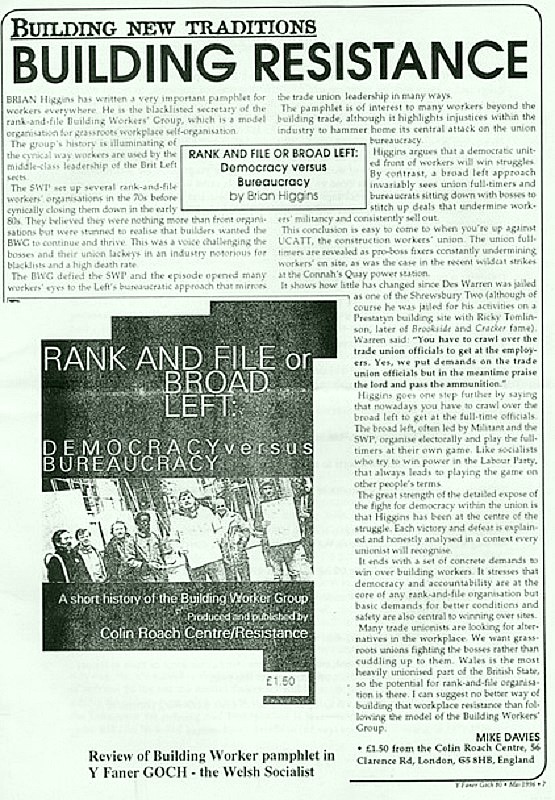
Brian’s file at the Consulting Association was the largest of any building worker on their list. Included in the information was a booklet I helped to bring out through the Colin Roach Centre (CRC) titled Rank and File or Broad Left: democracy versus bureaucracy

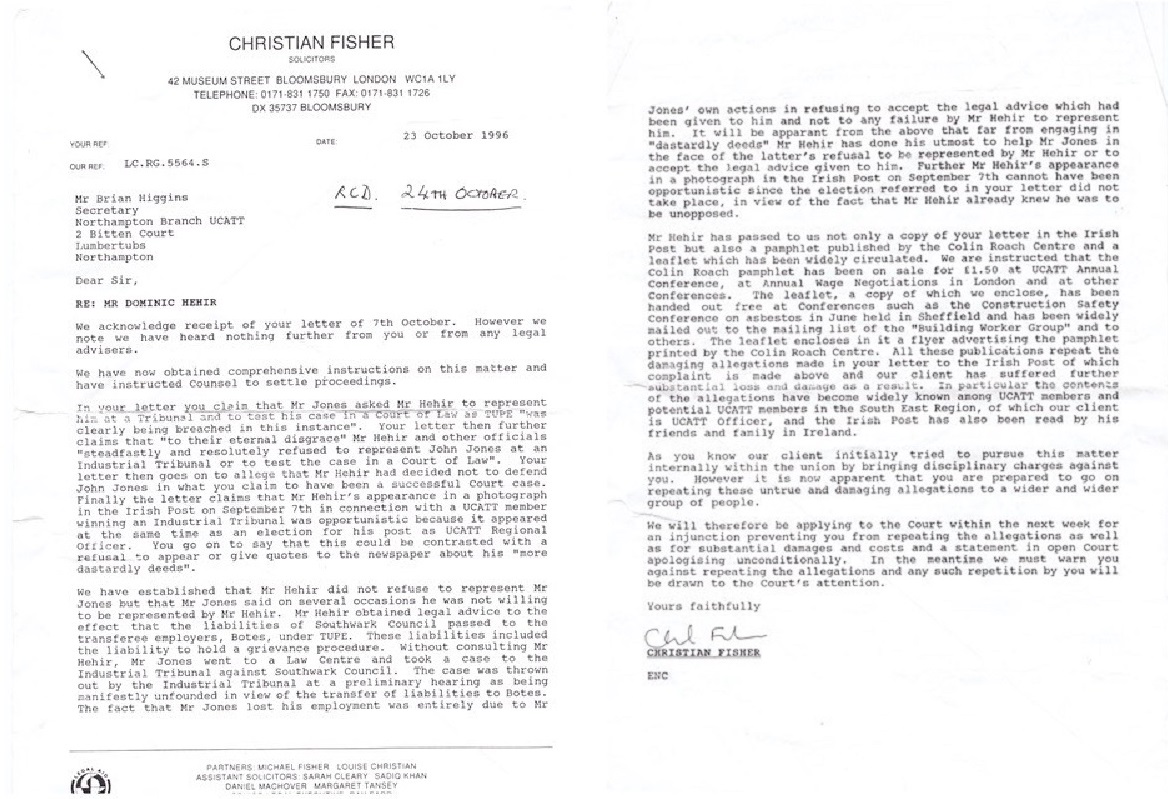
This work was also cited in an attempt by UCATT official Dominic Hehir in his attempt to sue Brian for libel. This is the only known case of a union official attempting to sue an ordinary member of a union. The attempt ultimately failed. A support group was set up to back Brian and the secretary of this group was Mark Cassidy, a member of the Colin Roach Centre, who was later found out to be Mark Jenner, a police spy. Jenner subsequently provided information on Brian and a number of other building workers to the Consulting Association.

Part of this Big Issue North article states:-

When UCATT officer Dominic Hehir sued BWG and union member Brian Higgins for libel over allegations he was failing to support members, a defence campaign was established – and Jenner became the chair. Although the campaign was successful the time taken up on Higgins’ defence meant there was little in reserve to picket sites. Those involved felt it was a hollow victory. Higgins, a blacklisted building worker, says: “I am appalled to discover ‘Mark Cassidy’ was actually an undercover police officer who used his cover as a building worker to infiltrate organisations the state does not like. It is like some Orwellian nightmare and it is surely time for decency, justice and democracy for blacklisted workers.”

Further reading: Undercover but within sites

Below are links to some of the documents in this case and about which I shall be writing more in the future. Note to book publishers – please get in touch if interested

  • Rank and File or Broad Left book
  • Article by Brian in the CRC magazine : Number 1 titled Death on the site
  • Article by Brian on the libel action in the CRC magazine : Number 2
  • Article by Brian in the CRC magazine : Number 3

See also the self published pamphlet by Des Warren – Shrewsbury: whose conspiracy? The need for an inquiry – on events during the 1972 Building Workers’ strike and which saw him later sent to prison along with Ricky Tomlinson.

You can also read the following documents:-

The 2 page letter from Louise Christian informing Brian Higgins about the libel action

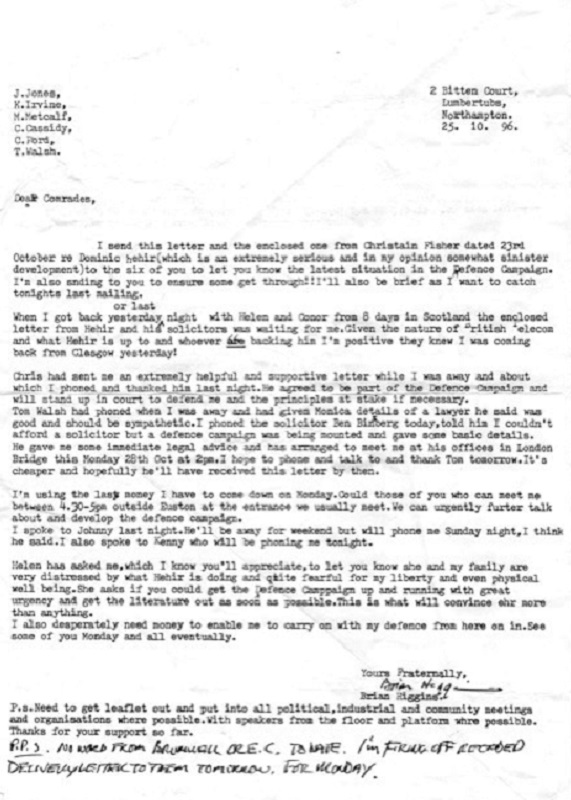
Brian’s 1-page reply to the above

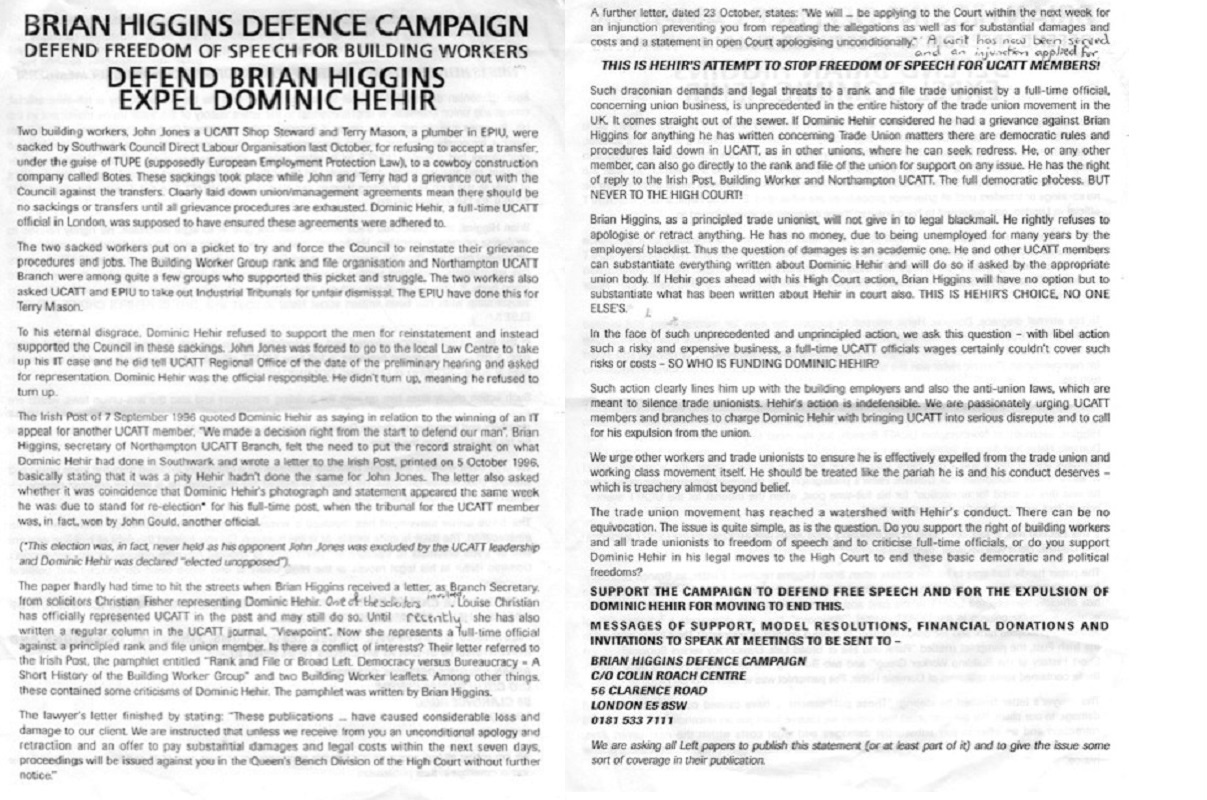
Brian Higgins Defence Campaign 2-page leaflet

Unpublished 2 page article sent to Workers Press

Victory – the letter by Louise Christian, civil rights solicitor (sorry hypocrite) on Hehir’s humiliating climbdown. Not one word that they lost, they proved now’t and couldn’t even be brave enough to admit it. Still, it did mean the original objective of Brian and others like myself of stopping sites when deaths occurred was lost – as time was otherwise spent on this legal attack by Hehir, who we still don’t know funded his actions.

Dominic Hehir’s infamous and ultimately unsuccessful High Court writ against Brian Higgins 

A century ago today Ted Harper of Blackburn Rovers scores against Burnley as he moves to become the first player to top 40 goals in a season


One century ago today Ted Harper scored the sixth goal for Blackburn Rovers as they thrashed neighbours Burnley 6-3 at Ewood Park.

Harper was on his way to becoming the first player to score over 40 league goals in a single season and finished with 43, 26 at home and 17 away out of a total of 91 Rovers goals. It is a record that no Blackburn player has ever come anywhere near emulating.

He was chased to the end by Sunderland’s David Halliday who would later equal his total in 1928-29. Despite Harper’s heroics his side only finished in twelfth place.

Born in Sheerness, Kent on 22 August 1901, Ted Harper arrived at Ewood Park in 1923 from Sheppey United on the strength of his goalscoring record in the Kent League. Critics said he looked clumsy and had no ball control, but as a goalscorer there were few better. He was quickly off the mark with eighteen goals in his first season.

In February 1925, Rovers signed Syd Puddefoot from Falkirk for £4,000. Despite being aged thirty, the ex-West Ham United favourite was a gifted playmaker whose vision and passing ability would particularly in light of the new rules that reduced the offside trap from three to two players carve out the sort of chances Harper could happily put away.

The result was that in their first full season, Harper was to become the first player to crash through the barrier of forty goals in a League season. It remains a record no one at Ewood Park has seriously threatened since.

Harper’s season hardly started with a bang, but after failing to be selected for the first three games of it all of which Rovers lost, including a 6-2 thrashing at Roker Park he scored a stunning five goals in his first match, aiding his side to a 7-1 win at Newcastle United. The home side had beaten Notts County heavily in the previous game and were in a confident mood before kick-off.

Few could have predicted how wonderfully the away side would play as a team, yet by half time they were already three goals up. Long before the end Harper joined the select band of players who have scored five goals in a top-flight match. He did it by staying well up the field, constantly seeking to break through Newcastle’s continued use of the offside trap that a few short years earlier had been the best in the business, but was now unable to come to terms with the law changes. With Puddefoot inside him and wingers Joe Hulme and Arthur Rigby outside, Harper was presented with numerous chances and did his best to grab as many goals as possible. In the event, five wasn’t too bad.

Back at Ewood, Harper then scored his first of the season there with a penalty against WBA. Two days later, at Bramall Lane, the Kent lad got his seventh of the season in a 1-1 draw.

There was a large crowd inside Ewood for the return fixture with Sunderland. They witnessed some of the qualities that had brought Rovers success at Newcastle. Puddefoot, given a roving commission, pulled the Wearsiders’ defence apart and after Rigby opened the scoring, Harper added two more in the second period in a 3-0 success. Harper’s nine League goals in just four matches rose to twelve in five in the next game as Cardiff were beaten 6-3 at Ewood Park.

Two more in his next two games meant it was fourteen in seven. Newcastle arrived much better prepared than in the first game and shocked the home support by winning 2-1, and also stopped Harper scoring for the first time in the season. Bolton repeated the feat at Burnden Park, but Notts County were unable to and his two goals, one a penalty, took Harper’s record up to sixteen in ten starts.

This rose to nineteen in eleven and as the hat-trick was at Turf Moor, there was extra joy for the Rovers fans that were able to make the short journey to Burnley. With the game tied on 60 minutes at 0-0, Harper pounced when Harold Hill and Jerry Dawson dallied over who should clear the ball. It was a typical opportunist goal, one of many the Rovers man happily picked up during his time with the club, and on 80 minutes he was again in just the right place to accept Puddefoot’s pass and make it 2-0. Just before the end, he again scored to ensure his side won 3-1. A penalty at home to Leeds the following weekend made it twenty in twelve games.

At home to Everton on Christmas Day, Harper got another couple. The first, reported the Liverpool Echo, was ‘a brilliant equaliser, Harper, after a run of many yards (in which he thrice mastered efforts by McDonald to stop him) leaving Hardy helpless with a fine shot. It was now twenty-five in nineteen games. Three more followed in his next four matches before a temporary blip in form saw him score just twice in Rovers next five games. One of these though was the sixth in a 6-3 hammering of Burnley at Ewood Park with eight of the goals coming in the second period with Rigby scoring three and Puddefoot the once.

Nevertheless, with seven from the next eight games it meant that prior to kick-off against Manchester United on 10 April, he had notched thirty-seven League goals and needed just two to overtake Everton’s Bert Freeman and Bolton’s Joe Smith, whose thirty-eight in 1908/09 and 1920/21 respectively remained a League record.

Furthermore, a hat-trick and Harper would also overtake David Brown as the top scorer in any league, the Darlington man having scored thirty-nine in the previous season’s Division Three North.

Despite his successes in front of goal, the Rovers man was not even assured of finishing as Division One top scorer. Sunderland’s David Halliday had already scored thirty-eight andwith Harper certain to miss Rovers’ penultimate game of the season to represent his country in his debut match against Scotland, he really needed to find the net.

He certainly did so, hammering home four goals in a 7-0 win. Each of his goals was greeted with special cheers, especially the second, which took him on to thirty-nine for the season.

The first was another piece of opportunism and cheeky skill, pouncing on the ball after Alf Steward had saved to drill it just inside the post as he fell backwards. Then, after beating Charlie Moore for pace, he cleverly placed the ball beyond the ‘keeper. His third was similar, a brilliant run and a powerful shot, and when he touched home his fourth the crowd roared its approval. Coming off, he then learned that Halliday had failed to score against Arsenal, leaving him three ahead of the Sunderland man.

It was the perfect boost prior to his first international, but with Puddefoot alongside him it was to prove a disappointing afternoon as Scotland won 1-0 at Old Trafford. Never selected again for his country, it meant Harper never played at Wembley because when Rovers got to the FA Cup final in 1928, he had already left the previous year to join Sheffield Wednesday.

Back home for the final League game of the season, Harper struck a further two goals against Aston Villa to take his season’s record to a remarkable forty-three goals in thirty-seven games.

At Sheffield Wednesday Harper scored thirteen goals in eighteen games and helped the Owls, with five goals in six games, capture the First Division title in 1928/29. He moved to Spurs in 1929 and scored sixty-two goals in sixty-three League games before returning to Lancashire with Preston in 1931. He saw out his career back with the Rovers in November 1933, before joining the club’s backroom staff until 1948. He broke individual goalscoring records at Blackburn, Tottenham and Preston during his career.

His Rovers record reads 177 League and FA Cup Apps, 122 goals. Ted died in Blackburn on 22 July 1959.

International Worker's Day honouring of Julia Varley in Bradford