Wednesday, 6 May 2020

Construction tops workplace deaths chart but agriculture remains most dangerous sector in 2019/2020

Construction tops workplace deaths chart at 37 workers in 2019/2020 whilst agriculture remains the most dangerous sector to work in 

The provisional figures for deaths at work from the Health and Safety Executive are 131 people. 37 are in the construction sector and 13 in agriculture. 

These figures confirm that agriculture remains the most dangerous sector to work in as it accounted for 10% of deaths despite employing just 1.4% of the overall workplace.  
Of the 13 killed, nine were self employed, almost certainly farmers, at an average age of 64 years and four employees, average age, 30 years. Most deaths are as a result of moving vehicles.

Construction has many more people working in it than construction but it does not employ 27% of the total workforce.  Yet that is its % figure when you see that the sector has recorded 37 of the 131 deaths to date.

The total figures, which will rise as the current list (dated May 5) records no deaths after 13 March, often takes time for deaths at work to be officially recorded, is 131.

The figures do not include military personnel. It will also be of interest to see how the HSE intends recording workers who have died from the coronavirus. 

Press release regarding Crystal Palace claim to be oldest league club

Mark Metcalf & Clive Nicholson, co-authors of FLYING OVER AN OLIVE GROVE: THE REMARKABLE LIFE OF FRED SPIKSLEY 

CPFC 1861 or 1905?
Why the Eagles oldest league club claim should be grounded.
 
Press release - 06/05/2020  
 
Eighty four page document (attached and at https://spiksley.com and at 

https://spiksley.files.wordpress.com/2020/05/01.-crystal-palace-full-doc-1.pdf
packed with primary/contemporary source materials show that the claim by Crystal Palace Football Club (CPFC) to be the oldest league club is an own goal
 
Crystal Palace Football Club, which is generally acknowledged to have been formed in September 1905, is claiming that their start date is 1861. This would make them the oldest League Club in the World. https://www.cpfc.co.uk/news/2020/april/crystal-palace-the-oldest-professional-football-club-in-the-world-formed-1861/
 
This is quite a claim and being very interested in football history we sought to see if it was true. Our examination was very thorough and has resulted in a 84 page document packed with primary/contemporary source materials - titled CPFC 1861 or 1905? Why the Eagles oldest League club claim should be grounded.
 
This can be downloaded for free at www.spiksley.com For those who are unaware of who Spiksley was then please see Phil Dawkes of the BBC article from last year at:- https://www.bbc.co.uk/sport/football/50139190
 
This document shows the CPFC claim is slightly absurd and is ultimately reduced to a short note in 1906 in the CPFC club handbook and which appears never to have been mentioned again anywhere by CPFC since very recently. It is possible to forget your own history but that really is a serious memory lapse. 
 
In the document we follow the qualification requirements as outlined by Martin Westby in his England’s Oldest Football Club’s 1815-1889: A New chronological classification of early football published last year. 
 
We reveal that the first CPFC side were affiliated to the FA between 1861 and 1875, at which point the club ceased to exist. There is then no FA affiliated club with the FA for a 30 year period until a new and totally separate club forms in 1905.
 
Are you the Corinthians in disguise? 

We show that CPFC played not a single League or Cup match between 1875 and 1905. We show how the 3 games in the mid 1890s under the banner of CPFC all contained 8-9 players from Corinthian FC. We show that on two occasion in January 1896 when these Corinthian players decided to play elsewhere other football clubs were drafted in to replace a team that was CPFC in name only and were in all matter of fact a failed marketing idea which aimed to provide a football spectacle to entertain the day crowds that visited The Palace’s many attractions.

Reports in 1895 and 1905 always reported that any club set up would be a new one with no mentions about any connection to the earlier Palace 1861-1875 
 
We show that the local and national press, which covered - and still does - extensively all football developments reported that moves to set up a CPFC in the mid 1890s always reported that this would be a new club. Claims by CPFC today that the failure at this time was due to the proposed club being barred from playing on the cricket pitch at The Crystal Palace are shown to be wrong. 
 
We show that all articles in the year leading up to and including September 1905 specifically mention this is a new club. We show how the 1905 claim comes up just once in a club handbook in 1906 being left hidden thereafter till well over a century later. 
 
We also show how the basis of many of CPFC’s claims are largely hypothesise of unproven facts which consist of using what events at other football clubs, such as the claim that as other professional clubs were set up out of cricket clubs then so must CPFC in 1905. 
 
We also prove that other claims by author Peter Manning that CPFC were keen to follow Woolwich Arsenal into professional football because the Gunners were averaging 25,000 gates are just outright wrong as it was not until they moved to Highbury that Arsenal, in 1919/20, averaged anywhere near such gates. CPFC had already existed for 15 years by this time.
 
We have sent all of this information to the FA, EFL, Crystal Palace, Nottingham Forest, the current oldest League club as they were formed in 1865, Notts County, now of the conference, formed 1862, plus Stoke City FC, who maintain an interest in the subject.
 
We are now making this document available to the press and to football fans in general. 
 
Enquires and requests for interview to:- 

Mark Metcalf - a member of the Sports Journalists’ Association, author of more books on pre WWI football than anyone, responsible for confirming that Kenny Davenport scored the first ever League goal at 3.47pm on Saturday 8 September 1888 
07392 852561 

Clive Nicholson
07792282808

Rough Jersey, named after the garments that the first professional footballers were required to wear, is a film production company currently working on a documentary on the early years of football. http://www.roughjersey.com/Projects/

CPFC two clubs , one exhibition team timeline-3.pdf

Tuesday, 5 May 2020

Book review on The Greatest Comeback: from genocide to football glory


THE STORY OF BELA GUTTMANN
THE GREATEST COMEBACK
From Genocide to Football Glory
David Bolchover 
Biteback Publishing £9.99 

This is a great biography about a great man. Hungarian born Bela Guttmann's life was dominated by football with both his playing and coaching career marked by considerable success across many countries and continents. 

His achievements though are even more remarkable as being Jewish they were set against the background of rampant anti-Semitism both before and after World War II plus, of course, the Holocaust and the systematic destruction of entire Jewish communities across many parts of Europe during the war. 

The story of how Guttmann survived the period 1939 to 1945 during which he often lived in hiding and later escaped from a forced labour camp would make it worth buying this book for that alone.

The book, which is meticulously researched and very well written, also reveals the part played by Jewish coaches and players and fans in the growth of football across Europe before 1945.

Hopefully this book will now be made into a film.


Budapest 1899 

Budapest in 1899 was a quarter Jewish. Unlike in many other parts of Eastern Europe, Jews were in the main accepted by the majority population and living free. Bela’s parents, like many of their generation had moved from a small rural town seeking employment in Hungary’s capital city. Although his father worked the pay was often poor. Bela went round as a youngster with a hungry stomach, which probably explains why during his footballing career he often moved from post to post seeking better contracts and financial security.

Guttmann stars for Jewish sides 

Just two years after his birth, the Hungarian league was formed and football immediately became  popular within Budapest. Guttmann’s age meant he missed having to fight in WWI and in 1918 he helped Torekves to third place in the Premier League. In 1921 he joined MTK, a club with strong Jewish origins, whose main rivals were Ferencvaros. MTK had benefitted from having Jimmy Hogan as club coach between 1916-1918. Hogan was decades ahead of his time and remains revered even today in Hungary. 

The MTK side was dominated by Jewish players and they strolled to the 1920/21 title. Guttmann scored as he won his first cap as Hungary beat Germany 3-0 in June 1921. 

In January 1922, Guttmann crossed the border to play for Hakoah Vienna FC, which wore a large Star of David on their shirts in a city where anti-semitism was rife and where Adolf Hitler was a citizen for many years. 

Playing in the USA

Playing before large Jewish crowds, Guttmann played his part in winning the title with Hakoah in 1926 but following a highly successful club tour of the USA in the summer of that year he, like many others, chose to leave behind the growing anti-semitism in Europe. He signed for New York Giants.  His wages increased considerably whilst his former club Hakoah subsequently declined. 

It is not well known but football was very popular in the 1920s in the USA, which also sent a national team to the inaugural World Cup in Uruguay in 1930. The Giants were an amalgam of central European Jews and native-born American and British players. Guttmann moved to newly formed New York Hakoah in 1928 and in what was his last success as a player he won the United States Open Cup in 1929 in a side containing Laszlo Sternberg, a Jew who later captained Hungary in their first World Cup Finals, in 1934. 

Coaches his side to the forerunner of the European Cup only weeks before WWII

Following the Wall Street Crash of 1929 and with the USA and many parts of the world in economic turmoil, Guttmann returned briefly to play and coach Hakoah Vienna before moving back to the USA in the year before WWII began. He clearly should have stayed there but such was his love for football, the popularity of which had collapsed in America, that he returned to Hungary to take over as coach in August 1938 at Upjest. Hungary had just passed laws imposing a quota system on how many Jews could be employed in a business. Although Hungary was not yet murderous it was certainly poisonous. 

Upjest had been formed by a Jewish industrialist Izsak Lowry and the side contained Gyula Zsengeller the goalscoring star of the Hungarian side that finished as runners up in the 1938 World Cup. Zsengeller netted 56 goals in 26 appearances as Guttmann’s side, playing the attacking style that all his sides did, won the 1939 Hungarian title. 

This put Upjest into the Mitropa Cup, the forerunner to the European Cup with two sides each from Hungary, Italy, the two times World Champions, and Czechoslovakia (World Cup finalists in 1934) plus one each from Romania and Yugoslavia. In July 1939, Upjest won the competition meaning as Europe descended into full-scale war the most prestigious European football club trophy was held by Guttmann which as Bolchover declares “was a fitting tribute to the continent’s jews who had played such a pivotal role in the development of the game.”

1939-45: Dodging death 

Guttmann was required to dodge death for the next six years. He was ironically helped by the fact that Hungary was on Germany’s side during the conflict. This meant the German’s didn’t move into the country until 1944. By then around 19,000 Jews had been deported to the Ukraine and where they were murdered. The remaining Hungarian Jews were crammed into ghettos with each Jewish house marked by a yellow star. 

The Holocaust that followed saw nearly half of the 250,000 Jewish Hungarian population murdered. Guttmann hid in small attic in the house of anti fascist Pal Moldovan, a Hungarian non-Jew. 

It later became obvious that if Guttmann was discovered during house-to-house searches being conducted by the Hungarian authorities this would leave Moldovan and his family open to persecution. Guttmann was forced to reveal himself and report for labour service, which he then escaped from in December 1944 amidst preparations being made to transport his labour company to concentration camps and certain death. 

Love 

When the war ended, Guttmann, aged 46, married his sweetheart Mariann, 13 years his junior, in November 1945. They stayed together until his death.

A globe-trotting coach 

Guttmann again became a football coach, this time at Vasas but he soon quit to take charge at Ciocanul Bucharest in February 1946. This role lasted a year and was his last personal association with a Jewish football club.

He moved back briefly to Upjest, coaching the side to the League Championship in 1946/47.

The Hungarian then set out as a globe-trotting coach with spells in Italy with Padova, Unione Triestina, Qualms in Argentina, Apoel Nicosia in Cyprus, AC Milan, where he should have gone to jail after he killed a young man whilst driving a car for which he had no licence, and Vicenza in Italy plus the army team Honved in Hungary in 1956-57. 

Portuguese successes 

Guttmann then enjoyed a successful short spell at Sao Paolo where he won the 1957 Brazilian title - the Campeonato Paulista - before leaving after Porto in Portugal offered him a larger salary. He then won the Portuguese title before leaving Porto to manage their hated rivals Benfica saying at the time “I sell my expertise to a club for a limited time.” Porto did not win the title again for 19 years. 

European Cup successes 

At the Stadium of Light, Guttmann successfully set about building an attacking Benfica side and the Lisbon club won the title in 1959/60 and 1960/61, which was also the season when they won the European Cup. After overcoming Double Winners Spurs in the semi-final Benfica beat Barcelona 3-2 in the final in Switzerland. 

In the summer of 1961, Guttmann was able to embed Eusebio into his side and the Mozambique black pearl was to become Portugal’s greatest player along with Ronaldo much later on. 3-2 down at half time in the 1962 European Cup Final in Amsterdam against Real Madrid, Benfica steamrolled their Spanish opponents in the second to win 5-3 with Eusebio netting two and later swapping shirts on the final whistle with Puskas, who had actually scored a hat-trick for the losing team. 

Like in the previous year, Benfica subsequently went on to lose in Intercontinental Cup (World Club Championship). Guttmann had by the time the games were played in September and October 1962 had again left at the height of his popularity after Uruguayan giants Penarol offered him a larger salary. Guttmann later quit just as Penarol were set to win the league title the following season. 

He was later offered the role as coach for Austria but amidst a constant background of antisemitic abuse and innuendo he soon quit. Now in this mid 60s, Guttmann’s powers were fading but having missed out on earning decent monies until he arrived in Milan in 1953 he was keen to cash in on his star status. He finally quit as a coach at aged 75 in 1974. 

He died in Vienna on 27 August 1981 and was buried the day after in a Jewish cemetery. The ceremony was presided over by Akiba Eisenberg, a Rabbi raised in the Hungarian town of Vac, where Guttmann had spent some time in a forced labour camp in 1944. 

Guttmann changed football forever. He was the first coach since Herbert Chapman at Huddersfield and Arsenal between the two wars, to define the role of manager or coach as it is known elsewhere. Others have followed since. 

Despite Guttmann’s achievements in the face or enormous adversity he remains little known and so bravo to David Bolchover for writing this book, which, to repeat I really hope will now be made into a film. 

Friday, 1 May 2020

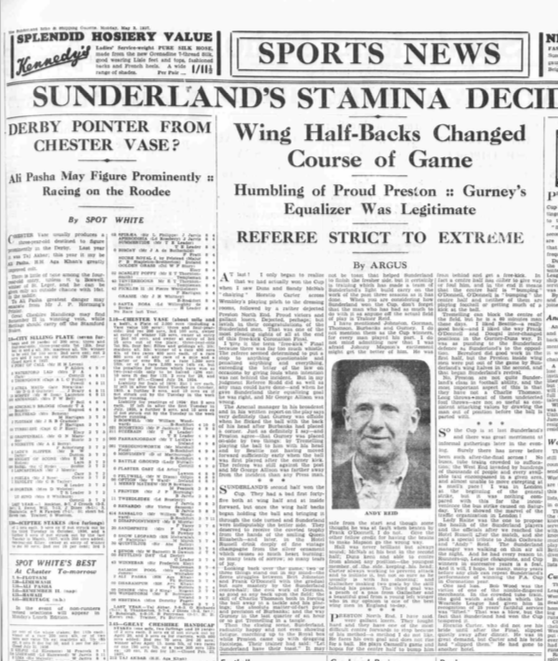
1 May 1937 PNE 1 Sunderland 3

Sunderland Echo, published around 4pm on 1 May 

Sunderland Echo, published around 4pm on 1 May with Sunderland 1-0 down 

Haway the Lads 

Bill Shankly "In  many ways the Sunderland side of 1937
played the same brand of Total Football as the
great Holland team of the 1970s." 

Was anyone better than Frank Swift in distributing the ball from his goal?

Was anyone better than Frank Swift in distributing the ball from his goal? 

Throwing the ball long distances was not possible for ‘keepers of the past as the leather ball could often go out of shape and on wet days it would collect water, becoming heavier. 

Frank Swift of Manchester City was a giant of a man and is arguably the greatest Englishman to set foot in goal. Certainly only Gordon Banks and Peter Shilton might have any claim to be better. 

Frank’s hands were certainly the largest of any English international keeper at a massive 11 3/4 inches span, enabling him to pick up the match ball with one hand. He could then hurl the ball long distances. He began to prefect his technique when he played for England in the series of WWII international’s that were held to keep up morale amongst the general public between 1939 and 1945.

Facing Scotland in October 1943 at Maine Road, England played brilliantly to win 8-0. The respected writer Ivan Sharpe later wrote it was perhaps the best performance by England since 1907. The seventh goal came when Swift launched the ball so far that it passed over the Scottish defence to allow Tommy Lawton, Swift’s great friend, to dash clear and score his fourth goal.

Swift was also good with his feet, knocking a lovely pass in 1947 up to Stan Pearson in the England forward line at Hampden Park, Pearson played a one-two with Tom Finney before netting in a match England won 2-0. Remarkably, Swift, who came from one of the poorest streets in Blackpool, played much of the match with two broken ribs after an earlier collision with Billy Liddell. Swift collapsed after the game ended.

Swift’s best game for his country was the Italy away game in May 1948. Big Frank was by now England’s first ever goalkeeping captain.  From the off the Italian’s, the reigning World Champions, reputedly on bonuses of £1,000 each to win the match, surged forward. 

Even when England counterattacked and shocked the 58,000 home fans by taking an early lead thought Blackpool’s Stan Mortensen, Italy swarmed all over the away defence. Swift made three glorious saves. He then showed again his remarkable throwing accuracy by making a precise throw to captain Billy Wright who sent it forward quickly for Blackpool’s Stanley Matthews to find Mortensen who sent Lawton free to make it 2-0. Swift was to make a further half a dozen saves as England went on to win 4-0, a scoreline that was ridiculous. 

England played two more friendly matches against local teams in Switzerland in the summer of 1948. Swift was by now performing a series of party tricks, flicking a bouncing ball over the head of opposing centre forwards before half volleying it to Matthews’ feet on the wing near the half way line. 

Frank Swift was killed at Munich on 6 February 1958. 

Copies available at £12 including postage
Details at: mcmetcalf@icloud.com 

Coming soon: Why The Eagles oldest league club claim should be grounded.


Thursday, 30 April 2020

The remarkable story of how Sunderland attracted a million fans to Roker Park in 1949-50 but lost the title due to a crucial injury to their top striker


In 1949-50, Sunderland AFC for the only time ever had over a million fans at their home League matches. The Wearsiders would almost certainly have won the title if not for an injury to the top scorer that season. Here is Dickie Davis's story for the season. Davis scored 25 League goals and was in great form as the season moved towards its climax. 

Adolf Hitler’s attacking ambitions delayed Birmingham-born Richard ‘Dickie’Davis’s League debut for Sunderland until he was aged twenty-four. He didn’t get on the scoresheet away to Leeds in December 1946, but when the Wearsiders returned to Roker Park he grabbed his first League goal against Liverpool. It proved to be one of five during the season. 
However, with manager Bill Murray preferring Cliff Whitelum at centre-forward, Davis was forced to bide his time at the start of the following season, being switched to inside- forward before finally appearing to make the number 9 shirt his own. 
The 1948–49 season was therefore a frustrating one as Davis found himself sharing the centre-forward spot with Ronnie Turnbull in a side in which record signing ‘Clown Prince’ Len Shackleton was the undoubted star. Davis was missing when Sunderland sensationally crashed out of the FA Cup when beaten by non-leaguers Yeovil Town. Having scored just seven times during the 1948–49 season, there was little to suggest that Davis, standing 5 feet 8 inches tall and weighing just over 11 stones, was about to set the First Division alight at the start of the 1949–50 season. 
Yet within 41 minutes of the opening match, Davis had knocked home his first of the season, and although Liverpool had beaten Sunderland 4-2 at Anfield, there was enough in Sunderland’s performance to suggest they were going to have a decent season. This was confirmed in the next game at Burnley, when the sides shared four goals, one of which Davis struck home on 12 minutes. It was reward for a fine performance that had the Journal reporter at the game stating, ‘Davis proved a constant menace to the Burnley goal. Cummings did a good job against him but could not prevent the centre forward putting in some dangerous shots.’ 
Shackleton was at his magnificent best when Sunderland played their first home game of the season, notching up two in a 4-2 victory against Arsenal, the Wearsiders’ first against the Gunners in fourteen years. Davis failed to get on the scoresheet and after five games without a goal, he was under pressure to deliver when Sunderland ran out to play Derby at the Baseball Ground in the eighth League game of the season. When he notched up Sunderland’s second just before half-time the away side seemed set to run out easy winners, but three second-half goals by the home side saw The Rams capture both points. 
Sunderland’s indifferent start to the season looked like it might continue when, with just 13 minutes of the home game to play against WBA, the score was tied. Then Davis, receiving a pass from Jack Stelling, pivoted sharply and shot past Jim Sanders to ensure a 2-1 victory. It was just the tonic he and his side needed, and the following weekend the man who’d guested for Aston Villa during the war was in impressive form against Manchester United at Old Trafford. First, on 9 minutes he hit a powerful shot that was going past ’keeper Jack Compton, only for Johnny Carey to get the last touch. Today such a goal would recorded as the striker’s, but if Davis was disappointed he didn’t show it as 6 minutes later, he eluded Allenby Chilton and met a perfect Tommy Reynolds centre first time, Sunderland eventually running off 3-1 winners. 
Sunderland’s next away game was at Newcastle and Davis was again to add his name to the scoresheet. There were doubts about whether his shot had crossed the line in a 2-2 draw, but there were no doubts about the quality of the finish, a back-heeler in a crowded goalmouth from 15 yards out. It was the sort of goal only a player in form would have attempted and Davis followed it up by opening the scoring in the first minute of the following weekend’s 2-1 home victory against Fulham.Two further goals followed in the next game at Roker Park, a header and then a tap-in after the Charlton legend Sam Bartram inexplicably dropped a simple cross at the centre-forward’s feet. 
With Sunderland and Davis maintaining their form into the New Year, the Wearsiders travelled to face Birmingham City in mid-January. The Blues had in goal one of England’s greatest ’keepers in Gil Merrick, but on 67 minutes he was to be left helpless by a magnificent Davis goal. Shackleton had crossed, but with the ball going away from both Davis and the goal, there seemed little danger before the Sunderland man leapt backwards to flick the ball over his head and past the startled Birmingham number one. 
It proved to be a crucial match winner and with his confidence now raised to new heights, Davis struck his first hat-trick when he scored half his side’s goals in a 6-1demolition of Derby. If there was then the shock of being well-beaten 5-1 at Second-Division Spurs in the FA Cup, it was not enough to prevent Sunderland continuing their League progress. 
Cup holders Wolverhampton Wanderers had a fine defence with England international Billy Wright at the centre and the man many feel is the best ever between the sticks for the Black Country side, Bert ‘the Cat’ Williams. Dickie Davis, though, was now in sparkling form and on 11 March 1950 he notched his second hat-trick of the season as Sunderland won 3-1 at Molineux. Centre-half Bill Shorthouse gave his much smaller opponent a right battering, but it failed to prevent him running off at the top of the First Division goal scorers’ chart with a total of twenty-three. It soon became twenty-five, as having hit the equalising goal at Fratton Park against reigning champions Portsmouth in a 1-1 draw, Dickie Davis then grabbed Sunderland’s second in a 2-2 draw at the Valley, nodding home a Tommy Wright cross with just three minutes remaining. 
Davis was off the scoresheet in the next two games. Both were played at Roker Park and it was the man playing at inside right, next to him, who was the star. Ivor Broadis had been Carlisle’s player-manager when Sunderland had enquired about employing his services, and so he duly became the first man to transfer himself when he moved from the west to the east coast at a cost of £18,000 in January 1949. After hitting both goals in a 2-0 win against Villa, Broadis again got both goals as Middlesbrough returned down the north-east coast beaten 2-0. The result, though, had come at a cost, Davis being injured in a collision with Boro ’keeper Rolando Ugolini that saw him limp out the second half on the wing. 
There were thirty-six games of the season gone and Davis had played in thirty-three of them and notched up twenty-five goals. He had scored 11 in the last twelve League games. 

Sunderland were just coming into form, and since losing to Stoke City at the Victoria Ground in late December had played twelve League games unbeaten, winning eight of them. 
Len Duns had been a fine servant for Sunderland, playing at Wembley when Preston were beaten in the FA Cup Final in 1937 and earlier collecting a League winner’s medal. He hadn’t, though, played a League game in over a year. Drafted in to play outside right, Sunderland reshuffled with Tommy Wright moved to play centre forward. Fulham were easily beaten 3-0 at Craven Cottage, but with Middlesbrough fighting for their lives a derby match at Ayresome Park was always going to be a difficult test. So it proved, as Sunderland went down 2-0. 
The performance saw further changes in the starting line up for the must-win home game with Manchester City. Bert Trautmann twice saved one of Stelling’s penalty kicks as Sunderland flopped 2-1. When Sunderland subsequently lost a third consecutive game, at Huddersfield, they were out of the title race even after they beat Everton 4-2 at home in the penultimate match of the season before what was easily the smallest home crowd of the season at 23,519. This dropped the Wearsiders average gate to 47,785, which is still the highest in the club’s history. 
Davis returned for the final match of the season and scored twice as Chelsea were beaten 4-2 before a Roker Park crowd of just 21,567, the lowest of the season. This was slightly fear than the 23,519 who had watched the Everton match. Yet despite these paltry attendances the 1949-50 season is when Sunderland recorded their highest average gates at 47,785. There were 21 League home games meaning 1,003,485 fans passed through the turnstiles during the season. The average home gate for the first 19 matches of the season was 50,442. 
Davis’s absence in the five of the last six games of the season had proven crucial and although he ended up with the honour of being the First Division top-scorer, he would surely have traded it for a League winner’s medal. Sunderland finished in third place just a point behind Champions Portsmouth. One more victory and a seventh title would have been recorded. 
Dickie Davis was to go on and make a total of 154 first team appearances for Sunderland before departing to play for Darlington in May 1954 after having hit seventy-nine goals on Wearside. The 1949–50 season was clearly the finest during his relatively short career. Sunderland were the League top scorers with eighty-three and Davis hit twenty-five of them. They included a beauty at St Andrews and two hat-tricks during a season in which Davis demonstrated his all-round goal-scoring abilities with goals from both left and right feet and his head. By finishing three goals in front of second-placed Stan Mortensen and Derby’s Jackie Stamps, Davis had shown that on his day he was up there with the best.