Thursday, 10 February 2022

‘CAUTIOUS OPTIMISM’ OVER CLADDING


‘CAUTIOUS OPTIMISM’ OVER CLADDING

Big Issue North magazine, 7-13 February 2022

There is cautious optimism among those trapped in properties with Grenfell Tower-type cladding that their campaigning has pushed the government into action to resolve their concerns about the possibility of a fire starting overnight and heavy insurance costs. The Grenfell Tower fire in North Kensington in 2017 killed 72 residents. Fire spread quickly up its exterior cladding, used on millions of properties.

Insurance costs

Julie Fraser, spokesperson for Liverpool Cladiators which supports residents with fire safety concerns, is a leaseholder at the Decks, a block of flats in Runcorn. She said: “After Grenfell, residents had safety concerns but in late 2017 we were informed by the agency that manages the flats everything was safe.


“Then in 2019 we were told the cladding was dangerous. We needed a waking watch [where trained staff continually patrol a building’s floors and perimeter to look out for fire]. Underground parking was prohibited by the fire service who also instructed us to pay to install new fire alarms. But people still live in fear.”

Julie Fraser 

Despite new safety measures the Decks total insurance costs of £33,000 in 2019 have leapt to £514,000 this year. These are passed on to residents in their quarterly service charges, which have rocketed. Liverpool Cladiators pushed housing secretary Michael Gove on the problem at a recent meeting.

“Mine was £254 and is now £719. A friend pays £770,” said Fraser. “Leaseholders nationally can’t cope and could lose their properties for non-payment. Campaign groups have spoken to the insurance industry but they pretend to be ignorant about the premiums we are paying.”

 Another Decks tenant, Paul Phair, fears he may lose his rented flat due to rising expenses, while an elderly resident who owns his property now fears it is worthless.

                                                            Paul Phair 


Following Grenfell, it was estimated that £30 billion needed spending on unsafe cladded properties. The government argued that tower blocks that remained dangerous failed to comply with regulations. Developers contended that regulations were at fault. Residents were caught in the middle.

Government U-turn

When the government was forced to agree to make tower blocks safe it allocated £5 billion in support. Progress has been slow. In January 2020, West Yorkshire Fire and Rescue Service (WYF&RS) wrote to residents in 13 tower blocks telling them they may have to leave their properties unless they had firm plans to remove dangerous cladding.

Two years on WYF&RS believes work is yet to be completed on six of them.

A spokesperson said: “The six buildings have substantial plans. Whilst we would like buildings that require defects to be remediated as quickly as possible, we must appreciate the availability of competent engineers to assess the requirements necessary together with the availability of contractors and equipment. Remediation works span years.

“Our officers work with building owners to ensure that adequate interim measures remain in place… we carry out routine checks.”

Government funds only covered blocks above 18 metres high. That ruled out support for three of the six blocks at the Decks. Leaseholders in smaller buildings were faced with taking out loans to remove unsafe cladding.

 In a sudden reversal of direction, Gove recently announced that leaseholders in buildings 11 to 18 metres in height will not have to contribute to replacing cladding. Instead, the £4 billion works “should be funded by the industries that profited… those who mis-sold dangerous products, such as cladding or insulation…. those who cut corners to save cash.”

Gove has threatened legal measures if the construction industry and developers do not thrash out a solution for payment, and asked the Financial Conduct Authority why insurance premiums have rocketed for many customers where cladding has not been removed.

Fraser said: “The devil is always in the detail. Michael Gove appears open to discussion and has promised regular meetings. I believe he wants to get a grip of this.

“He is putting the onus on the developers and manufacturers. Many are donators to the Tory Party and we don’t believe that they will take this lying down. They will put up a fight. “So will we because it is only through campaigning that we have made progress and there is still a long way to go.”


                                                 The Decks, Runcorn

All photographs are copyright of Mark Harvey of ID8 Photography 


Thursday, 3 February 2022

THE SECRET LIES IN THE SOIL


THE SECRET LIES IN THE SOIL

Landworker magazine article 

Many agricultural experts – including Unite’s food security and soil scientist, Dr Charlie Clutterbuck,  believe soil quality is critical for the future of the UK’s food supply.

Experts have welcomed the government’s decision to pay farmers to improve it for the first time.

But doubts still remain over how soil quality will be assessed, the mechanism for paying farmers and whether there are sufficient scientists and research facilities to provide farmers with advice.

Following Brexit, the European Union’s Common Agricultural Policy farm subsidies are being phased out and replaced with the Sustainable Farming Incentive (SFI) scheme, to be introduced next year.

According to the Department for Environment, Food and Rural Affairs (Defra), the SFI is “centred around incentivising sustainable farming practices alongside profitable food production and rewarding farmers for producing public goods such as better air and water quality, protecting wildlife and improving soil health”.

The plans also include under the government’s 25-year Environment Plan a net zero carbon ambition.

But as Landworker readers know all too well ‘profitable food production’ will always trump sustainable farming.

Soil quality and biodiversity supports agricultural production and the storage of carbon. But almost 4 million hectares of soil in England and Wales are at risk of compaction, according to the Environment Agency, and 2 million hectares are at risk of erosion.

Intensive agriculture has caused arable soils to lose 40-60 per cent of their organic carbon, said the Environment Agency in July. But it added that there is insufficient data on soil health and called for investment in monitoring.

Farmers can sign up to SFI schemes to improve arable and horticultural soils at payments between £30 and £59 per hectare and grassland soils at £6-£8 per hectare. Under the EU basic payments subsidies scheme farmers received £230 per hectare.

“Not only is the money that once went direct to farmers being replaced by the SFI but half of this funding, £2bn, will be cut and replaced by schemes that the government has yet to announce, based on the new natural environment investment readiness fund (NEIRF),” commented Clutterbuck.

Clutterbuck is himself part of the Ribble Valley consortium NEIRF bid led by the Larder Project in Preston, which includes key organisations like the NFU.

. NEIRF will provide natural capital grants of between £10,000 and £100,000 to “people interested in tackling climate change, creating and restoring habitats or improving water quality”. Again, no mention of food.

Clutterbuck said much of the money on the bid he worked on is set aside for consultants at £500- £600 a day.

 “These consultants will be focused on attracting large scale funding, whereas in the past farmers big or small got direct payments. Jobs will be lost.”

Clutterbuck fears that attracting large-scale private sector investment will mean large scale landscape picture box projects rather than a working countryside.

 “As such,” he continued, “ a good number are likely to be rewilding and tree plantation projects, neither of which will, after an initial boost, provide long-term employment for local people. “

 According to a Defra spokesperson: “Healthy soil is key to supporting our targets on the environment and improving farm profitability. Well managed soils can lead to increased biodiversity, increased carbon sequestration and storage, improved water quality and flood prevention.”

Yet there are actually no specific soil targets in the Environment Act. When the Lords sought - through an amendment at the Bill stage - to include legally binding targets government the minister in charge, Rebecca Pow, admitted it did “not yet have the reliable metrics needed to set a robust target …. and to measure its progress.” The Tories refused to accept the amendment.

Instead, there is to be a Soil Health Action Plan (SHAPE) to develop indicators, methodology and monitoring. SHAPE will provide  a ‘strategic direction’ but there is no completion target. There has previously been hardly any monitoring on soil quality and in 2020, England spent just £283,780. This compared to £60.5 million on monitoring water quality and £7.65 million on air.

 In response, Luke Pollard, shadow rural affairs secretary, said, “Improving soil health is a vital goal, but without establishing a comprehensive environmental baseline, as we suggested during the passage of the Agriculture Act, it will be hard to measure and achieve.”

Clutterbuck believes monitoring soil quality should begin with “an England-wide measurement of soil carbon”, a legally binding commitment to improving soil quality and investment in more research facilities.

In response a Defra spokesperson said it was planning a “comprehensive programme of soil monitoring across farms participating in the early roll-out. The first stage will be establishing a baseline for a range of soil health indicators.”

 The spokesperson added, “There is a wealth of expertise in soil health within the UK including scientists from the University of Lancaster and UK Centre for Ecology & Hydrology.”

 Many land research facilities were lost after Margaret Thatcher drew a line between ‘pure’ research, that would be publicly funded, and ‘practical/applied’ research that would be funded by industry. With agriculture being an applied science there thus began a long decimation of land-based research facilities. Three quarters of research stations and many unionised, highly skilled jobs have gone as Britain moves steadily towards importing ever more of its food.

Universities are, at least, now looking to set up additional research and accompanying facilities to help farmers seeking to improve soil quality. A Plymouth University spokesperson said, “We have recently developed new modes of study in this area through our accredited degrees in regenerative farming, with specific modules dedicated to the study of soil health and the range of methods for improving soil quality. Building on the continued success and popularity of our 6-month sustainable horticulture residency at Schumacher College, and the complimentary online course in sustainable growing, we are now increasing this provision through the MSc in Regenerative Food, Farming and Enterprise starting in January, and the BSc in September. “

Felicity Crotty, senior lecturer in soil science at the Royal Agricultural University, also welcomed moves to improve soil quality but warned that testing every field “would be expensive and not every farmer knows how much carbon is in their soil.

We do research on soil health, teach a couple practical modules on soil and environmental science and sustainable soil, and water management. We take the students out into the field and they learn about how to do a visual examination of soil structure, learn about the importance of soil biology and monitoring earth worm numbers.

“We would hope to do more in the field of soil health and with everyone talking about it then you’d expect there would be great government funding in the future,” she added.

Crucially, Clutterbuck has calculated that Britain, which currently imports half its food, could reduce this to around 25-30 per cent through better land management and improving soil content. In turn, this would mean more rural jobs plus many countries that currently export to Britain could begin to grow food for their own people, many of whom go hungry.

“We need that better soil to produce more local produce to regenerate rural communities and not fund carbon offset schemes that benefit the City,” added Clutterbuck.

SFI will be phased in over seven years, while in the next three years farmers will lose half their former EU subsidies. They mean more to smaller northern hill farmers, earning around £25,000 annually, than larger farmers on richer plains. We understand there are many farmers who have worked for generations, are now being offered incentives to quit the land.

But this quite appalling state of affairs is at odds with Boris Johnson’s promise, made in 2016 at a cattle market in Clitheroe, that farmers would get the same amount of money – “100% guaranteed” – from subsidies after leaving the EU, while being relieved of red tape.

Clearly this is not the case. The first SFI schemes will start in the spring.  But according to environmental law expert Richard Smith, “few farmers have signed up to the new programme”.

This has not surprised Pollard. He said, “We have long warned that the new Environmental Land Management schemes, including the SFI, are over-complicated and that many farmers will find them hard to access – that is being borne out by experience as we have seen numbers coming forward to take part in tests and trials falling far short of Government predictions.”

A Defra spokesperson said it was planning a “comprehensive programme of soil monitoring across farms participating in the early roll-out. The first stage will be establishing a baseline for a range of soil health indicators.”

And the way forward? Last words go to Dr Charlie Clutterbuck.

“The labour movement should be supporting plans to improve soil health as that can provide jobs in research and advisory roles, plus it would mean training to proper vocational standards. It could be part of a programme to regenerate rural affairs by creating many more land based jobs as I sought to outline in my 2017 book BITTERSWEET BREXIT – the future of food, farming, land and labour.” Charlie is available to speak at labour and trade union meetings and can be contacted on charlie@sustainablefood.com


Unite gathers cross-party and community support to keep Northern Ireland wages board


“We remain hopeful that we can defeat this latest attack on the Agricultural Wages Board. The Ulster Farmers’ Union and its cheerleaders in the Democratic Unionist Party (PUP) are not finding their plans to scrap the AWB plain sailing. The majority of respondents to the Department of Agriculture’s public consultation opposed abolition of the AWB.”

Donal O’Cofaigh, Unite Campaigns, Communications & Press (NI)

In January 2021, the Northern Ireland (NI) Agriculture, Environment and Rural Affairs Minister Edward Poots of the Democratic Unionist Party announced his intention to end the Northern Ireland (NI) AWB that covers over 11,000 agricultural sector employees. Poots is a member of the Ulster Farmers’ Union (UFU) which champions the interests of big ranchers and the agri-food bosses.

Unite immediately opposed the proposal with regional officer Sean McKeever stating: “there is a particular need for a collective bargaining body covering agricultural field workers………the sector receives a huge amount of public funds ..it is one which is inherently difficult to organise given the scattered distribution of workers and the prevalence of part-time working……..

“The AWB is of vital importance in countering exploitation, which all too often includes the practice of trafficking and modern-day slavery  – especially as many are migrant workers with little other protection.” The AWB is the final NI collective bargaining mechanism in with a responsibility for private sector workers.

Success

Unite has sought with considerable success to get organisations to respond to the subsequent Department of Agriculture public consultation and the majority who did so want to see the NI AWB retained.

This included the entire trade union movement, the official rural community network of Northern Ireland, rural councils including Fermanagh & Omagh District Council, and even small farmer organisations like ‘Family Farmers for Action.’

Unite’s submission highlighted the vital role the AWB has, amongst many other things, played in:

·         securing incomes for workers above the bare minimum under the national minimum wage;


·         providing protection to vulnerable workers e.g., through setting minimums and enforcement standards for piece rates;


·         guaranteeing overtime pay at 1.5 times the standard rate of pay;


·         providing enhanced levels of Sick and Holiday Pay and entitlements;


·         providing protection for section 75 groups;


·         maintaining a mechanism for collective bargaining in the agricultural sector.


If the AWB was to be abolished then workers would only by covered by the considerably weaker National Minimum Wage.

Britain and Ireland’s largest union stressed how the abolition of the AWB would place agricultural workers at a disadvantage when compared with current pay, terms and conditions with particular impacts on young, migrant and male workers.

Small farmers link arms with Unite as they seek a guaranteed price structure to pay decent wages

Family Farmers for Action UK (FFA) agreed to back retaining the AWB after they were approached by Unite. According to organiser William Taylor: “FFA has discovered the corporate influence in government. The countryside has become nothing more than slavery and which is why FFA, Belfast Hills Farmers, Farmers For Action UK, Northern Ireland Agricultural Producers Association and Northern Ireland Livestock Auctioneers Association are promoting a NI Welfare Bill that is with the agriculture committee for scrutiny. “

If the Bill was to get through the assembly then farmers would be paid a Fair Farm Gate Prices Index. This will specify the lowest price to be paid for best-quality produce, across the entire gamut of agricultural commodities produced in Northern Ireland.

This would mean, said Taylor:  “that instead of the major supermarkets setting down what farmers would get it would be the other way round. By obtaining a guaranteed price then the farmer would always have the money to pay his staff properly and to build proper facilities such as toilets and showers. We would have no problems with the AWB addressing the issues that staff have on farms. The plans would also create 10-20,000 new jobs. “

Taylor believes the decision by the UFU to open up membership to corporate companies such as Tesco and Sainsbury’s means the body does not properly represent farmers. He argues that in England the major supermarkets would, if faced with a similar proposed piece of legislation, simply tell Boris Johnson it is not allowed to progress. “That is not happening here. I am confident we can win the battle. If we do then it will influence prices elsewhere across the rest of Britain and Ireland. Farmers everywhere will want similar guarantees and if we can get it then we can raise the 25 per cent of UK farmers who live below poverty level up to a decent income. “

The Rural Community Network (RCN) is a voluntary organisation supporting rural communities across Northern Ireland. Spokesperson Aidan Campbell said it wished to retain the AWB rate for many reasons including as  “an important incentive for young people… entering the industry… to remain within agriculture and seek formal qualifications and skills………progression opportunities for young people in rural communities can contribute to the sustainability of rural areas…. The AWB helps ensure agricultural workers have reasonable terms and conditions.. including holiday entitlement, holiday pay and a level of sick which is additional to statutory sick pay.” The RCN has criticised the Department of Agriculture for failing to engage and obtain the views of agricultural workers who will be directly affected if the AWB is abolished.

The strength of opposition means that according to Donal O’Cofaigh: “For the decision to abolish the AWB to proceed, DUP Minister Edwin Poots will need to secure cross-party support within the NI Executive. Unite is actively calling on all Executive parties to use their vote to save the AWB. Already Sinn Fein and the SDLP have indicated their opposition to abolition as have smaller parties in the Assembly including Greens and People before Profit. We have to keep the pressure on to ensure that these promises turn into a veto.”

Bring back the AWB in England

O’Cofaigh also believes:  “if we can retain the AWB in Northern Ireland, that leaves England as the only part of the UK without a collective bargaining structure in place for agricultural workers. If we are successful it might reopen the way to raise the demand for the re-establishment of the AWB in England  - and indeed in the Republic of Ireland - to protect all agricultural field and farm workers across these islands.” The stakes therefore are high.


The below may be useful if you want to remind readers of the current impact of the loss of the AWB on young English workers.


Young English workers lose out 

Whereas young workers in Scotland, Wales and Northern Ireland are covered under their respective AWB’s those in England are only covered by the National Minimum Wage.

As such a 20-year-old agricultural worker in Scotland is thus guaranteed £356.40 for a 40-hour working week, in Northern Ireland it is £299.60 and in Wales the figure is £313.60. The sum in England is £262.40, considerably less than elsewhere. The differences for a young person in England aged 18 or under is even greater. It is hardly surprising that young workers in England are not considering entering the agricultural sector.

AWBs also cover pay for workers or all ages in lieu of wages, sick pay, holiday pay, piece rates, overtime rates at 1.5 times the standard rate and it limits deductions for accommodation to a flat rate and which in Northern Ireland is £45 weekly.

NHS faces ‘exodus’ of dentists


NHS faces ‘exodus’ of dentists

Big Issue North magazine article.

Long-term problems exacerbated by Covid

Patients take dental care into own hands

Two northern MPs have added their voice to calls for more funding for dental care amid fears that it is becoming increasingly difficult for adults and children to find an NHS dentist who will treat them.

The lack of access to dental care, which has been a concern for more than 15 years in some areas, has worsened during the pandemic, with dentists exiting the profession in large numbers, leaving it “hanging by a thread”, according to a British Dental Association (BDA) leader.

According to Healthwatch, the statutory body that represents patients, lack of access to NHS dentistry has “exploded as an issue for people over the last 18 months”. Patients needing urgent care are left in “excruciating pain” – with one reporting they had pulled out their own tooth – and many are forced to go private. Using NHS Digital data, last December Healthwatch said only 11 per cent of the more than 5,000 dental practices in England were accepting new adult NHS patients, and only 17 per cent took on new patients.

Regional inequality

The headline figure masked large regional and sub-regional variations. A quarter of North East and Yorkshire practices accepted adult patients. But in the North West and the South West, that figure dropped to 1 per cent.

Only 4 per cent of North West practices accepted children.

Healthwatch North Yorkshire found that of the 77 NHS practices in the area, only two would take on new adult patients for NHS treatment. Healthwatch Blackburn reported that all the 21 practices in its area on the NHS website were refusing to take on NHS patients for the foreseeable future. In May and June, Healthwatch York also found not a single practice taking on NHS patients.

 York Central MP Rachael Maskell has long warned of an NHS crisis in her constituency. Referring to a pre-pandemic Healthwatch report, she said: “46 per cent of people in York could not find an NHS dentist and 45 per cent of those searching had been looking for more than two years. I can testify to this from the amount of correspondence I get on the matter.

“In talking to the BDA, around 30 per cent of dental nurses are unvaccinated so could leave the profession by the end of March, and many dentists are leaving NHS dentistry or the profession altogether.”

Heightened by pandemic

Although the crisis has been heightened by the pandemic – with dentists forced to drastically reduce the appointments they can offer because of the need for restrictive PPE and distancing measures – it stems from the 2006 introduction of a controversial new contract for dentists paying them for activity rather than patient numbers.

As far back as 2007, Big Issue North reported that just 13 per cent of surgeries in the North West were taking on new patients – despite the new system being meant to create more places. And in Leeds, nearly a quarter of the city’s 138 dental practices had gone private.

 Now, according to analysis of NHS data by the BBC, almost 1,000 dentists in England and Wales left the NHS last year. The BBC quoted one patient, forced to wait for treatment for over a year, who used a metal file and superglue to perform her own treatment.

That exodus is “just the tip of the iceberg”, according to the BDA, which warned that “NHS dentists who have never contemplated working outside the system are now looking to the exit”. Its December survey suggested over 40 per cent of dentists are now likely to change career or seek early retirement in the next 12 months.

Over half stated they are likely to reduce their NHS commitment. One in 10 thought their practice will close in the next 12 months. The government has imposed a target of resuming 85 per cent of pre-Covid activity but there was no increase in spending for dental care in Chancellor Rishi Sunak’s package of extra NHS funding in his budget of October last year.

“Years of failed contracts and underfunding have meant a growing number of dentists no longer see the NHS as a place to build a career,” said Shawn Charlwood, chair of the BDA’s general dental practice committee. “The pandemic has upped the ante and we are now facing down an exodus.

“Integral to healthy society”

“Ministers have failed to grasp that we can’t have NHS dentistry without NHS dentists. Rather than punishing colleagues, we need a service that recognises and rewards commitment. Millions stand to lose out if the government fails to deliver needed reform.”

 Increasing public support for an NHS dentist for everyone is leading to a growing number of campaigns across the North. The launch late last year of the Toothless in Suffolk campaign led to a national organisation being formed.

Toothless in England spokesperson Mark Jones said: “The public’s oral, general and mental health has continued to suffer in the face of a dental crisis brought about by successive years of government neglect and underfunding by the Treasury of a critical NHS service.” Toothless in England is demanding an NHS dentist for everyone and treatment free at the point of use, with free routine check-ups and preventive treatment. It wants reforms to the dental contract to encourage dentists to provide NHS treatments and an end to NHS dentistry privatisation. Toothless campaigns have started this month in Newcastle and Manchester. People in other towns and cities have also made contact with the national campaign.

Allison Fewtrell, a South Manchester resident, said: “The campaign is resonating with Greater Manchester communities, and people have contacted us with a variety of problems. Some can’t get an affordable dentist and have had no treatment for years. Others have suffered with problems that are preventable with regular dental care. People have endured chronic toothache and lost teeth.”

Kim Johnson, MP for Liverpool Riverside, said: “I regularly receive e-mails from constituents asking where they can find an NHS dentist for themselves or – quite often – their children. I cannot give them any options.

“I would like a return to free dental care and increased services, especially for children. Dentistry should be integral to ensuring a healthy society.”

Government response

In response to a series of questions, a Department of Health and Social Care spokesperson (DHSC) said: “We have taken unprecedented action to support NHS dentists throughout the pandemic by providing full income protection for practices unable to deliver their usual level of activity.

“Children, who continue to be eligible for free NHS dental treatment, are being prioritised alongside vulnerable patients and those with urgent dental needs. “Nearly half of all dental treatments – over 17 million – were provided free of charge in 2019-20.”

According to the DHSC, dental charges contribute towards the running costs of the NHS and NHS England has a duty to commission dental services to meet local need. Where a patient cannot get access to an NHS dentist, NHS England is expected to provide help in doing so.

MARK METCALF

Campaign pushes Welsh Government into introducing CCTV in slaughterhouses

 Unpublished article for Landworker magazine of Unite the Union 

The Welsh Labour Government is making it mandatory for all Welsh slaughterhouses to install CCTV by 2023/24.  The move  brings Wales in line with England and Scotland after the latter introduced mandatory CCTV on 1st July 2021. The pressure is now on Northern Ireland to follow suit. The Welsh Government’s decision forms part of a new ‘Animal Welfare Plan’ that is being rolled out over the next 5 years.

The animal welfare charity Animal Aid (AA) campaigns against all forms of animal abuse and promotes cruelty-free living. AA has undertaken groundbreaking undercover investigations on farms, ‘game bird’ establishments and slaughterhouses.

 In 2019, AA released footage of the sixteenth, and the first in Wales, slaughterhouse they had filmed in.

Video footage from the Farmers Fresh Maelor Abattoir in Wrexham appeared to show sheep being pulled along by their legs, dragged by their throats, kicked and thrown by workers, some of whom pinned down and cut the throat of what appeared to be a fully conscious sheep. Animals were hurled down the slaughter conveyor line.

AA urged the ‘Welsh Government to introduce mandatory CCTV in slaughterhouses to help vets with better regulation and monitoring, to provide footage for training and retraining, to deter some of the animal welfare abuses we filmed and to provide evidence for prosecutions should they be necessary.’

At the start of 2020 there were 24 slaughterhouses in Wales. Yet despite a voluntary joint protocol adopted in 2017 between the Food Standards Agency  and the industry only 10 slaughterhouses had CCTV installed. The Welsh Government had made funding available for CCTV equipment installation.  

Slaughterhouses without CCTV must now install them over the next few years in areas where live animals are present after new rules were included in the Animal Welfare Plan for Wales published by Welsh rural affairs minister Lesley Griffiths: “Whilst CCTV cannot replace direct oversight by slaughterhouse management or Official Veterinarians (OVs), it can improve the efficiency of monitoring and enforcement activity. CCTV can provide OVs with the information they need to monitor compliance with the welfare at the time of killing regulations more readily and more conveniently. This will support improved consumer confidence that welfare standards are being delivered.

“There will be requirements for slaughterhouse operators to allow enforcement agencies to access footage and for footage to be stored for a specified period. “

The Welfare Plan also includes a pledge to develop a country-wide model to monitor and enforce animal welfare standards, registration for commercial breeders (for pets or for shooting), animal welfare establishments, and animal exhibits, the boosting of qualifications of animal welfare inspectors and restrictions of the use of cages for farmed animals. 

“Our ambition is for animal welfare in Wales to be recognised for its exemplary standards,” said Griffiths, who was first elected to the Welsh Assembly in 2007.

Tor Bailey, Campaign Manager, Animal Aid welcomed the “decision by the Welsh Government to bring Wales in line with England and Scotland. Animals at slaughterhouses are extremely vulnerable – they are in the total power of people, many of whom have become desensitised, paid to end their lives… We urge the Welsh government to bring forward strict rules regarding the placement and operation of cameras, access and storage of footage. Full independent monitoring of footage is vital to help safeguard farmed animals. “


Support Tahir Mehmood, general secretary of Metro Habib Employees’ Union, Pakistan


Support Tahir Mehmood, general secretary of Metro Habib Employees’ Union, Pakistan

Unpublished article for Landworker magazine, January 2022

If you’ve got a bit of spare time to support trade unions internationally who are struggling for their rights then please consider linking up with the campaigns page at Labour Start, which provides news from every part of the planet.

UNI Global Union federation represents over 20 million workers in 150 countries, mainly those employed in the private sector including commerce. UNI has over 900 affiliated unions, including Unite.

In March 2021, UNI Commerce began an international campaign against ‘union-busting at Metro AG stores in Pakistan following the unfair dismissal in February of Tahir Mehmood, General Secretary of Metro Habib Employees Union.’ (MHEU)

In response, Labour Start launched an online support drive that asked supporters to send to Andreas Euenheim, Chief Human Resources Officer of Metro AG, a message urging Metro Pakistan to stop denying workers’ calls for a collective bargaining agreement and to reinstate Tahir Mehmood and other dismissed trade unionists. Since 2013 every elected general secretary of MHEU has been sacked by Metro Pakistan. Mehmood was dismissed for absenteeism that occurred in 2017.

Over 7500 people responded by sending a message, thus putting pressure on Metro A.G which is a multinational German-based food wholesaler that operates in 26 countries. A new online company initiative calling for ‘Time for a New Togetherness’ was countered by unions taking photos of solidarity banners posted on social media asking Metro ‘What about Pakistan?’

Following the campaign, UNI Commerce and Metro AG have met. According to Mathias Bolton,  Head of Department for UNI Commerce, “We are happy that thousands of people around the world and trade unions from more than 30 countries responded to our call for solidarity and joined us in asking respect for trade union rights in Pakistan. Following our campaign, we held several meetings with Metro AG. We have submitted our reports and findings on the violation of trade union rights in Pakistan and we expect a positive outcome.”

In the event of Metro being forced to reinstate Mehmood and agreeing to a bargaining agreement with MHEU then this would be a considerable success for the trade union movement in Pakistan.  This can be traced back to the pre-independence period and  the introduction of railways and agriculture plantations. Following independence from British rule in 1947, most employers, largely the government, opposed the formation of trade unions but by the 1960s the government understood that to boost productivity it needed the support of workers and it offered better deals including the right to combine.

Today, just 1.8 million, around per cent of workers in Pakistan are trade union members. As in Britain, the law of the land does not encourage collective action, seeks to quell trade unionism and blocks workers from taking solidarity strike action. Many workers are on short term contracts with no fixed hours.

Labour Start

https://www.labourstart.org/news/index2019.php

https://www.labourstartcampaigns.net/actnowen.cgi?l=en

Other current campaigns at Labour Start feature Colombia, Iran, Algeria, Jordan, Puerto Rica and Myanmar.

UNIGLOBAL

https://www.uniglobalunion.org

UNITE internationally

https://www.unitetheunion.org/what-we-do/international/solidarity-work/

https://www.unitetheunion.org/what-we-do/international/european-federations/

https://www.unitetheunion.org/what-we-do/international/european-federations/


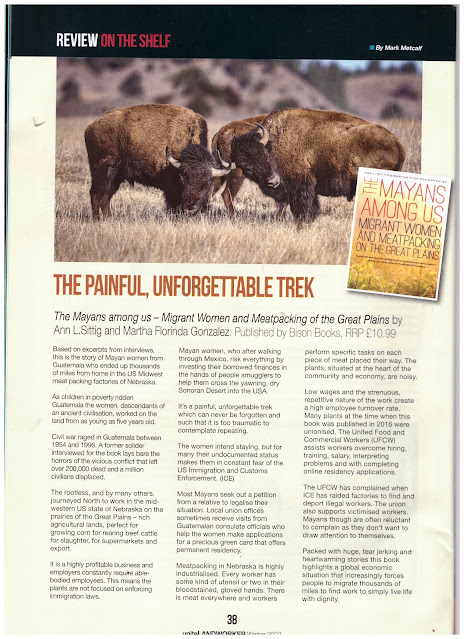
THE PAINFUL, UNFORGETTABLE TREK


THE PAINFUL, UNFORGETTABLE TREK

THE MAYANS AMONG US - Migrant Women and Meatpacking of the Great Plains

Ann L. Sittig & Martha Florinda Gonzalez (who emigrated from Guatemala to Nebrasksa)

Published by Bison Books, RRP £10.99

Based on excerpts from interviews, this is the story of Mayan women from Guatemala who ended up thousands of miles from home in the US Midwest meat packing factories of Nebraska.

As children in poverty ridden Guatemala the women, descendants of an ancient civilisation, worked on the land from as young as five years old. They received hardly any education as it was assumed that as adults the women would look after their husbands and children.

Civil war raged in Guatemala between 1954 and 1996. When President Jacobo Arbenz began redistributing land to the poor the USA under President Eisenhower organised Operation Success. Arbenz was replaced by US Army-trained Carlos Castillo Armas. Guerilla activity began across Guatemala in 1960. In 1970, President Carlos Arana Osario started assassinating his opponents and those suspected of sympathising with the insurgents.

A former solider interviewed for the book lays bare the horrors of the vicious conflict that left over 200,000 dead and a million civilians displaced.

The rootless, followed later by many others, journeyed North to work in the midwestern U.S. state of Nebraska that encompasses the prairies of the Great Plains. These rich agricultural lands are perfect for growing corn on which beef cattle are reared for slaughter with the meat then packed and transported to the major supermarket chains and for export.

It is a highly profitable business and employers such as Tyson, JBS, Swift, Cargill and Excel constantly require able-bodied employees. This means the plants are not focused on enforcing immigration laws.

Mayan women, who after walking through Mexico, risk everything by investing their borrowed finances in the hands of people smugglers to help them cross the yawning, dry Sonoran Desert into the USA.

It’s a painful, unforgettable trek which can never be forgotten and such that it is too painful to contemplate repeating.

On eventually reaching Nebraska the women, whose intention is to find work and then send as much money home as possible, seek support from an established Mayan community in which religious beliefs and strong  family ethics are key.

The women intend staying, but for many their undocumented status does not allow for any future security or investments. A constant fear exists of coming to the attention of the U.S. Immigration and Customs Enforcement. (ICE) 

Most Mayans seek out a petition from a relative to legalise their situation. Local union offices sometimes receive visits from Guatemalan consulate officials who help the women make applications for a precious green card that offers permanent residency.

Meatpacking in Nebraska is highly industrialised. Every worker has a designated spot and job to do and some kind of utensil or two in their bloodstained, gloved hands. There is meat everywhere and workers perform specific tasks on each piece of meat placed their way. The plants, situated at the heart of the community and economy, are noisy.

Low wages and the strenuous, repetitive nature of the work create a high employee turnover rate. Many plants at the time when this book was published in 2016 were unionised. The United Food and Commercial Workers (UFCW) assists workers overcome hiring, training, salary, interpreting problems and with completing online residency applications.

The UFCW has complained when ICE has raided factories to find and deport illegal workers. The union also supports victimised workers. Mayans though are often reluctant to complain as they don’t want to draw attention to themselves.

Packed with huge, tear jerking and heartwarming stories this book highlights a global economic situation that increasingly forces people to migrate thousands of miles to find work to simply live life with dignity.