Thursday, 3 February 2022

NHS faces ‘exodus’ of dentists


NHS faces ‘exodus’ of dentists

Big Issue North magazine article.

Long-term problems exacerbated by Covid

Patients take dental care into own hands

Two northern MPs have added their voice to calls for more funding for dental care amid fears that it is becoming increasingly difficult for adults and children to find an NHS dentist who will treat them.

The lack of access to dental care, which has been a concern for more than 15 years in some areas, has worsened during the pandemic, with dentists exiting the profession in large numbers, leaving it “hanging by a thread”, according to a British Dental Association (BDA) leader.

According to Healthwatch, the statutory body that represents patients, lack of access to NHS dentistry has “exploded as an issue for people over the last 18 months”. Patients needing urgent care are left in “excruciating pain” – with one reporting they had pulled out their own tooth – and many are forced to go private. Using NHS Digital data, last December Healthwatch said only 11 per cent of the more than 5,000 dental practices in England were accepting new adult NHS patients, and only 17 per cent took on new patients.

Regional inequality

The headline figure masked large regional and sub-regional variations. A quarter of North East and Yorkshire practices accepted adult patients. But in the North West and the South West, that figure dropped to 1 per cent.

Only 4 per cent of North West practices accepted children.

Healthwatch North Yorkshire found that of the 77 NHS practices in the area, only two would take on new adult patients for NHS treatment. Healthwatch Blackburn reported that all the 21 practices in its area on the NHS website were refusing to take on NHS patients for the foreseeable future. In May and June, Healthwatch York also found not a single practice taking on NHS patients.

 York Central MP Rachael Maskell has long warned of an NHS crisis in her constituency. Referring to a pre-pandemic Healthwatch report, she said: “46 per cent of people in York could not find an NHS dentist and 45 per cent of those searching had been looking for more than two years. I can testify to this from the amount of correspondence I get on the matter.

“In talking to the BDA, around 30 per cent of dental nurses are unvaccinated so could leave the profession by the end of March, and many dentists are leaving NHS dentistry or the profession altogether.”

Heightened by pandemic

Although the crisis has been heightened by the pandemic – with dentists forced to drastically reduce the appointments they can offer because of the need for restrictive PPE and distancing measures – it stems from the 2006 introduction of a controversial new contract for dentists paying them for activity rather than patient numbers.

As far back as 2007, Big Issue North reported that just 13 per cent of surgeries in the North West were taking on new patients – despite the new system being meant to create more places. And in Leeds, nearly a quarter of the city’s 138 dental practices had gone private.

 Now, according to analysis of NHS data by the BBC, almost 1,000 dentists in England and Wales left the NHS last year. The BBC quoted one patient, forced to wait for treatment for over a year, who used a metal file and superglue to perform her own treatment.

That exodus is “just the tip of the iceberg”, according to the BDA, which warned that “NHS dentists who have never contemplated working outside the system are now looking to the exit”. Its December survey suggested over 40 per cent of dentists are now likely to change career or seek early retirement in the next 12 months.

Over half stated they are likely to reduce their NHS commitment. One in 10 thought their practice will close in the next 12 months. The government has imposed a target of resuming 85 per cent of pre-Covid activity but there was no increase in spending for dental care in Chancellor Rishi Sunak’s package of extra NHS funding in his budget of October last year.

“Years of failed contracts and underfunding have meant a growing number of dentists no longer see the NHS as a place to build a career,” said Shawn Charlwood, chair of the BDA’s general dental practice committee. “The pandemic has upped the ante and we are now facing down an exodus.

“Integral to healthy society”

“Ministers have failed to grasp that we can’t have NHS dentistry without NHS dentists. Rather than punishing colleagues, we need a service that recognises and rewards commitment. Millions stand to lose out if the government fails to deliver needed reform.”

 Increasing public support for an NHS dentist for everyone is leading to a growing number of campaigns across the North. The launch late last year of the Toothless in Suffolk campaign led to a national organisation being formed.

Toothless in England spokesperson Mark Jones said: “The public’s oral, general and mental health has continued to suffer in the face of a dental crisis brought about by successive years of government neglect and underfunding by the Treasury of a critical NHS service.” Toothless in England is demanding an NHS dentist for everyone and treatment free at the point of use, with free routine check-ups and preventive treatment. It wants reforms to the dental contract to encourage dentists to provide NHS treatments and an end to NHS dentistry privatisation. Toothless campaigns have started this month in Newcastle and Manchester. People in other towns and cities have also made contact with the national campaign.

Allison Fewtrell, a South Manchester resident, said: “The campaign is resonating with Greater Manchester communities, and people have contacted us with a variety of problems. Some can’t get an affordable dentist and have had no treatment for years. Others have suffered with problems that are preventable with regular dental care. People have endured chronic toothache and lost teeth.”

Kim Johnson, MP for Liverpool Riverside, said: “I regularly receive e-mails from constituents asking where they can find an NHS dentist for themselves or – quite often – their children. I cannot give them any options.

“I would like a return to free dental care and increased services, especially for children. Dentistry should be integral to ensuring a healthy society.”

Government response

In response to a series of questions, a Department of Health and Social Care spokesperson (DHSC) said: “We have taken unprecedented action to support NHS dentists throughout the pandemic by providing full income protection for practices unable to deliver their usual level of activity.

“Children, who continue to be eligible for free NHS dental treatment, are being prioritised alongside vulnerable patients and those with urgent dental needs. “Nearly half of all dental treatments – over 17 million – were provided free of charge in 2019-20.”

According to the DHSC, dental charges contribute towards the running costs of the NHS and NHS England has a duty to commission dental services to meet local need. Where a patient cannot get access to an NHS dentist, NHS England is expected to provide help in doing so.

MARK METCALF

Campaign pushes Welsh Government into introducing CCTV in slaughterhouses

 Unpublished article for Landworker magazine of Unite the Union 

The Welsh Labour Government is making it mandatory for all Welsh slaughterhouses to install CCTV by 2023/24.  The move  brings Wales in line with England and Scotland after the latter introduced mandatory CCTV on 1st July 2021. The pressure is now on Northern Ireland to follow suit. The Welsh Government’s decision forms part of a new ‘Animal Welfare Plan’ that is being rolled out over the next 5 years.

The animal welfare charity Animal Aid (AA) campaigns against all forms of animal abuse and promotes cruelty-free living. AA has undertaken groundbreaking undercover investigations on farms, ‘game bird’ establishments and slaughterhouses.

 In 2019, AA released footage of the sixteenth, and the first in Wales, slaughterhouse they had filmed in.

Video footage from the Farmers Fresh Maelor Abattoir in Wrexham appeared to show sheep being pulled along by their legs, dragged by their throats, kicked and thrown by workers, some of whom pinned down and cut the throat of what appeared to be a fully conscious sheep. Animals were hurled down the slaughter conveyor line.

AA urged the ‘Welsh Government to introduce mandatory CCTV in slaughterhouses to help vets with better regulation and monitoring, to provide footage for training and retraining, to deter some of the animal welfare abuses we filmed and to provide evidence for prosecutions should they be necessary.’

At the start of 2020 there were 24 slaughterhouses in Wales. Yet despite a voluntary joint protocol adopted in 2017 between the Food Standards Agency  and the industry only 10 slaughterhouses had CCTV installed. The Welsh Government had made funding available for CCTV equipment installation.  

Slaughterhouses without CCTV must now install them over the next few years in areas where live animals are present after new rules were included in the Animal Welfare Plan for Wales published by Welsh rural affairs minister Lesley Griffiths: “Whilst CCTV cannot replace direct oversight by slaughterhouse management or Official Veterinarians (OVs), it can improve the efficiency of monitoring and enforcement activity. CCTV can provide OVs with the information they need to monitor compliance with the welfare at the time of killing regulations more readily and more conveniently. This will support improved consumer confidence that welfare standards are being delivered.

“There will be requirements for slaughterhouse operators to allow enforcement agencies to access footage and for footage to be stored for a specified period. “

The Welfare Plan also includes a pledge to develop a country-wide model to monitor and enforce animal welfare standards, registration for commercial breeders (for pets or for shooting), animal welfare establishments, and animal exhibits, the boosting of qualifications of animal welfare inspectors and restrictions of the use of cages for farmed animals. 

“Our ambition is for animal welfare in Wales to be recognised for its exemplary standards,” said Griffiths, who was first elected to the Welsh Assembly in 2007.

Tor Bailey, Campaign Manager, Animal Aid welcomed the “decision by the Welsh Government to bring Wales in line with England and Scotland. Animals at slaughterhouses are extremely vulnerable – they are in the total power of people, many of whom have become desensitised, paid to end their lives… We urge the Welsh government to bring forward strict rules regarding the placement and operation of cameras, access and storage of footage. Full independent monitoring of footage is vital to help safeguard farmed animals. “


Support Tahir Mehmood, general secretary of Metro Habib Employees’ Union, Pakistan


Support Tahir Mehmood, general secretary of Metro Habib Employees’ Union, Pakistan

Unpublished article for Landworker magazine, January 2022

If you’ve got a bit of spare time to support trade unions internationally who are struggling for their rights then please consider linking up with the campaigns page at Labour Start, which provides news from every part of the planet.

UNI Global Union federation represents over 20 million workers in 150 countries, mainly those employed in the private sector including commerce. UNI has over 900 affiliated unions, including Unite.

In March 2021, UNI Commerce began an international campaign against ‘union-busting at Metro AG stores in Pakistan following the unfair dismissal in February of Tahir Mehmood, General Secretary of Metro Habib Employees Union.’ (MHEU)

In response, Labour Start launched an online support drive that asked supporters to send to Andreas Euenheim, Chief Human Resources Officer of Metro AG, a message urging Metro Pakistan to stop denying workers’ calls for a collective bargaining agreement and to reinstate Tahir Mehmood and other dismissed trade unionists. Since 2013 every elected general secretary of MHEU has been sacked by Metro Pakistan. Mehmood was dismissed for absenteeism that occurred in 2017.

Over 7500 people responded by sending a message, thus putting pressure on Metro A.G which is a multinational German-based food wholesaler that operates in 26 countries. A new online company initiative calling for ‘Time for a New Togetherness’ was countered by unions taking photos of solidarity banners posted on social media asking Metro ‘What about Pakistan?’

Following the campaign, UNI Commerce and Metro AG have met. According to Mathias Bolton,  Head of Department for UNI Commerce, “We are happy that thousands of people around the world and trade unions from more than 30 countries responded to our call for solidarity and joined us in asking respect for trade union rights in Pakistan. Following our campaign, we held several meetings with Metro AG. We have submitted our reports and findings on the violation of trade union rights in Pakistan and we expect a positive outcome.”

In the event of Metro being forced to reinstate Mehmood and agreeing to a bargaining agreement with MHEU then this would be a considerable success for the trade union movement in Pakistan.  This can be traced back to the pre-independence period and  the introduction of railways and agriculture plantations. Following independence from British rule in 1947, most employers, largely the government, opposed the formation of trade unions but by the 1960s the government understood that to boost productivity it needed the support of workers and it offered better deals including the right to combine.

Today, just 1.8 million, around per cent of workers in Pakistan are trade union members. As in Britain, the law of the land does not encourage collective action, seeks to quell trade unionism and blocks workers from taking solidarity strike action. Many workers are on short term contracts with no fixed hours.

Labour Start

https://www.labourstart.org/news/index2019.php

https://www.labourstartcampaigns.net/actnowen.cgi?l=en

Other current campaigns at Labour Start feature Colombia, Iran, Algeria, Jordan, Puerto Rica and Myanmar.

UNIGLOBAL

https://www.uniglobalunion.org

UNITE internationally

https://www.unitetheunion.org/what-we-do/international/solidarity-work/

https://www.unitetheunion.org/what-we-do/international/european-federations/

https://www.unitetheunion.org/what-we-do/international/european-federations/


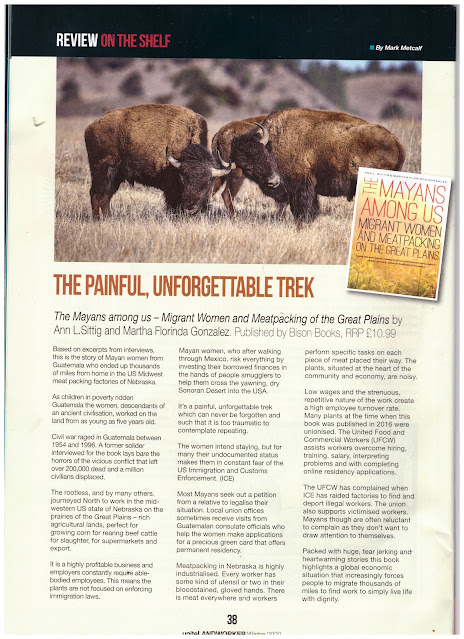
THE PAINFUL, UNFORGETTABLE TREK


THE PAINFUL, UNFORGETTABLE TREK

THE MAYANS AMONG US - Migrant Women and Meatpacking of the Great Plains

Ann L. Sittig & Martha Florinda Gonzalez (who emigrated from Guatemala to Nebrasksa)

Published by Bison Books, RRP £10.99

Based on excerpts from interviews, this is the story of Mayan women from Guatemala who ended up thousands of miles from home in the US Midwest meat packing factories of Nebraska.

As children in poverty ridden Guatemala the women, descendants of an ancient civilisation, worked on the land from as young as five years old. They received hardly any education as it was assumed that as adults the women would look after their husbands and children.

Civil war raged in Guatemala between 1954 and 1996. When President Jacobo Arbenz began redistributing land to the poor the USA under President Eisenhower organised Operation Success. Arbenz was replaced by US Army-trained Carlos Castillo Armas. Guerilla activity began across Guatemala in 1960. In 1970, President Carlos Arana Osario started assassinating his opponents and those suspected of sympathising with the insurgents.

A former solider interviewed for the book lays bare the horrors of the vicious conflict that left over 200,000 dead and a million civilians displaced.

The rootless, followed later by many others, journeyed North to work in the midwestern U.S. state of Nebraska that encompasses the prairies of the Great Plains. These rich agricultural lands are perfect for growing corn on which beef cattle are reared for slaughter with the meat then packed and transported to the major supermarket chains and for export.

It is a highly profitable business and employers such as Tyson, JBS, Swift, Cargill and Excel constantly require able-bodied employees. This means the plants are not focused on enforcing immigration laws.

Mayan women, who after walking through Mexico, risk everything by investing their borrowed finances in the hands of people smugglers to help them cross the yawning, dry Sonoran Desert into the USA.

It’s a painful, unforgettable trek which can never be forgotten and such that it is too painful to contemplate repeating.

On eventually reaching Nebraska the women, whose intention is to find work and then send as much money home as possible, seek support from an established Mayan community in which religious beliefs and strong  family ethics are key.

The women intend staying, but for many their undocumented status does not allow for any future security or investments. A constant fear exists of coming to the attention of the U.S. Immigration and Customs Enforcement. (ICE) 

Most Mayans seek out a petition from a relative to legalise their situation. Local union offices sometimes receive visits from Guatemalan consulate officials who help the women make applications for a precious green card that offers permanent residency.

Meatpacking in Nebraska is highly industrialised. Every worker has a designated spot and job to do and some kind of utensil or two in their bloodstained, gloved hands. There is meat everywhere and workers perform specific tasks on each piece of meat placed their way. The plants, situated at the heart of the community and economy, are noisy.

Low wages and the strenuous, repetitive nature of the work create a high employee turnover rate. Many plants at the time when this book was published in 2016 were unionised. The United Food and Commercial Workers (UFCW) assists workers overcome hiring, training, salary, interpreting problems and with completing online residency applications.

The UFCW has complained when ICE has raided factories to find and deport illegal workers. The union also supports victimised workers. Mayans though are often reluctant to complain as they don’t want to draw attention to themselves.

Packed with huge, tear jerking and heartwarming stories this book highlights a global economic situation that increasingly forces people to migrate thousands of miles to find work to simply live life with dignity.


Monday, 17 January 2022

‘For the first time I could talk about what had happened’


‘For the first time I could talk about what had happened’

BIG ISSUE NORTH 10 - 16 JANUARY

When Sasha’s ex-partner broke a formal agreement to stop stalking and harassing her and even travelled 900 miles to keep up his threats, she sought safety in a women’s refuge. Now living in another city free from the threat and able to live a fulfilling life, she describes the value of her eight months in the refuge. Interview: Mark Metcalf


In our last edition we reported on women’s refuges 50 years after campaigner Erin Pizzey set up the first one in Chiswick. Refuges provide a safe place to stay for women – and some men – who have been the victims of domestic violence. Those who run them have also, over the years, brought changes in the law to help women and helped train police and public bodies in how to understand domestic violence. According to the ONS, 1.6 million women aged 16 to 74 years experienced domestic abuse in 2019-20. But the 261 refuges in the country have to turn away people in need each day. There is a shortfall in their government funding of around £200 million, according to the charity Women’s Aid. Sasha*, a survivor of domestic violence, explains just how important women’s refuges are.

Why was it necessary for you to enter a refuge?

Sasha: Over many years I was harassed and stalked by my ex-partner. It became impossible to live in my hometown. He would show up at the homes of my friends and family demanding to know where I was, he made threats to harm me and himself if he wasn’t given information he wanted. One time he travelled almost 900 miles looking to find me. His friends and some family members would report my whereabouts to him and publicly harass me and so I would spend less time outside, becoming anxious and deeply depressed.

I kept all of my social media private, limited the friends I made to ensure no parts of my life would get back to him and avoided public events so I could reduce the risk of being seen.

Eventually my ex-partner escalated his threats from vague messages about how I needed to “watch out” to specific allusions that he would kill himself and that it would be my fault.

When I finally sought help for his many years of verbal, mental and emotional abuse he was told by police in no uncertain terms to stop harassing me. He signed an agreement stating he would stay away from me. He broke this at least four times over the following months, finally again showing up at my house.

 I was forced to leave the job I loved. I moved away from my friends, family and support network to live in a refuge in another city where I remained throughout legal proceedings.

It was devastating uprooting my life overnight but it was better for my wellbeing. For the first time I could talk about what had happened and the impact it had had on my mental health and sense of self.

For years I missed out on many things I wanted to do with my loved ones and found it hard to feel happy or look forward to anything. I constantly feared what my ex would say or do next, and what would happen if I ever reported it.

I thought I was better off saying nothing and keeping my head down. I now realise how much it took from me to keep everything to myself and how hard it was on my friends and family to see him break me knowing they couldn’t help.

What was it like living in a refuge?

At first it was a relief to be in a city where I knew no one and was unknown. But it was also tough to trust that I was able to relax and go for a walk or run errands in the city without having to factor in who might see me. I sought to make myself as inconspicuous as possible.

The isolation and solitude could be quite hard because I couldn’t hang out with my friends and I missed important moments in people’s lives. I couldn’t spend time with my family doing ordinary stuff like dog walks but they always made an effort to see me whenever possible and kept me in the loop – which I appreciated.

 I was always acutely aware that it’s not “normal” to have to hide your whereabouts from the people in your life to such an extent that they could only really know which city I lived in. When they visited I met them at a designated meeting place away from the refuge. But it keeps yourself and others safe, and though you may not know the stories of the other women and children in the refuge, you can relate to their need to have security and anonymity.

Despite its downsides the refuge was still a sanctuary. It was the one place where I wasn’t treated as a victim or like I was inherently delicate or broken. I still am a person who experienced horrible, scary things but there’s more to me than that. The refuge granted me the space to figure out who I was again, time to learn new skills like coding and peace of mind knowing I could live normally again.

The first refuge opened 50 years ago...

I dread to think how many women and children have needed to use refuge services in those 50 years, but I’m so grateful that that support system was there for them and hopefully it kept them safe and gave them a way to start fresh.

Refuges are incredibly important safety nets. Having lived in one for eight months I have seen how much goes into ensuring that women feel safe, empowered and advocated for.

Having all-women staff and support workers that listen to you, treat you with care and compassion and seek out the help and support you need without judgment is really validating. I can’t thank those women enough.

How is life since leaving the refuge?

 I was very fortunate to have been taken seriously by the police, to have had legal support throughout the court proceedings and to have successfully obtained a stalking protection order so my ex cannot come near me for the next five years. I’ve gained some of my life back.

It’s taken a lot of therapy and time for me to leave the constant state of survival mode I existed in for so long, but I finally feel like I can look forward to progressing in my life and career and to be able to focus on what I want rather than what will keep me safe.

Since leaving the refuge I’ve moved to a new city and taken the leap to go self-employed. I’m doing work in my local area planning and delivering workshops around race and identity and encouraging schools and communities to implement programming that celebrates diversity and inclusion.

 I’d like to build my business to cover more of the city and offer arts-based initiatives to people in communities that need them most. I’ve always been passionate about grassroots initiatives and I’m really excited to be doing something I love and making a difference to the lives of others.

Thank you to everyone – friends, family and Refuge support workers – for helping me along the way. The growth had to come from me but it wouldn’t have been possible without you all.

*Name has been changed. You can read our original article in the News section of bigissuenorth.com


WOMEN’S REFUGES, FIFTY YEARS ON


WOMEN’S REFUGES, FIFTY YEARS ON

Big Issue North magazine

Nationwide network aids victims of violence

Campaigners have also brought changes to law

The heroic women who opened the first refuge for domestic violence victims 50 years ago could never have envisaged it would lead to a nationwide network of secret locations that annually help thousands of women seeking to rebuild their lives free of their abusers.

 It was on 3 November 1971 that the first refuge opened. Its spokeswoman was Erin Pizzey, who had opened a social centre near her home in Chiswick. This changed dramatically when a badly bruised woman arrived with her children saying no one could help her. Chiswick Women’s Aid, now known as Refuge, was born. Discreet notices were put in newspapers telling victims they and their children could receive help. Many did.

Eighteen women and 46 children began living in the house in Chiswick, sleeping on shared mattresses. The lack of personal space was overlooked because everyone felt safe. The premises though were too small.

Unused house

Pizzey unsuccessfully approached local councils for help so the group started squatting, taking over any unused house. These swiftly became full.

Interviewed by the BBC recently, Pizzey, now aged 82, said: “The police couldn’t do anything because it wasn’t illegal then – and no council would want to have to rehome 15 mothers and their children every time.

“We even squatted in the 47-suite Palm Court Hotel in Rochamond.

The refuges were run communally with important decisions made by vote. Everyone mucked in. Pizzey inspired other women. Other refuges – 40 alone in 1974 – were established. Providing safe and secure accommodation for women went alongside publicising the issue of domestic abuse for the first time.

The National Women’s Aid Federation was established in 1974. Refuge is a member and is the country’s largest provider of specialist domestic and gender-based violence services. Refuge supports at its public community projects and refuges over 6,000 women and children on any given day.

One of the early refuges in the North was in Warrington, where Betty Tebbs led a campaign by Warrington and District Battered Wives Association to open one. In her autobiography Tebbs, who died in 2017, wrote: “When I asked for assistance from local councillors, all male, they told me there was no need for such a place as no one had asked for one before.”

Violent episodes

This response prompted the campaigners to set up a women’s aid group in 1976, which raised enough money to buy a cheap three bedroom terraced house in 1978. It could house three women and up to four children.

According to Tebbs: “Volunteers were found to repair and decorate the property… donations helped purchase equipment and fittings.

“When social services contacted the home it was the responsibility for whichever volunteer was on call to pick up and maintain ongoing welfare support for the woman


and her children needing assistance.”

 So exhausting was the work that eventually only a handful of volunteers could maintain their involvement. The refuge could only keep going when social services agreed to run it at night.

This was still no easy task and Tebbs, a retired printworker, faced a number of tricky, potentially violent episodes when aggressive partners objected to women leaving the family home. She occasionally needed the police to collect a woman’s belongings from the home she had just quit.

“Women suffered for many years before they took the decision to leave the home they helped build,” she wrote. Warrington Women’s Aid exists today. It can house 13 women and 19 children.

‘Huge upheaval’

As refuges grew, they increasingly needed paid staff and sought new funding streams. Where funds permitted, they provided training for police officers and those working in the criminal justice system about how domestic violence affects women. They started a national abuse helpline, and specialist projects for black and ethnic minority women, some of whom had no recourse to public funds.

The centres mounted campaigns to support survivors of domestic and sexual violence and to improve legislation and various criminal justice procedures. Sometimes workers had to physically defend the centres and residents when perpetrators discovered their locations. After a long campaign, in 1991, rape in marriage in England and Wales became illegal. Previously it was argued that what happened behind closed doors stayed there.

 According to ONS data for the year 2019/2020, 1.6 million women aged 16 to 74 years experienced domestic abuse. Over 100 women and three men are killed annually by their partners or ex-partners. One in three women aged 16-59 will experience domestic abuse in her lifetime.

There were 261 refuges in England in 2020, down from 294 in 2010, with bed space for 3,578 people. Refuges have to turn away around 90 people and their children each day because of lack of space.

Maria Edwards, operations manager at Refuge, believes the need for refuges is the same as in 1971.

“Women and children need an emergency place to flee domestic abuse, which is the biggest societal abuse impacting on women,” she said.

“It is a huge upheaval to leave your home and support network, including removing children from school, and be plonked miles away. Specialist staff in refuges help women settle in comfortably and provide one-to-one emotional and practical support whilst constantly thinking ‘safety, safety.’

“Services are signposted from local and senior government, police, doctor surgeries, the NHS, housing departments and other statutory places.”

 What has changed since 1971 are the methods by which domestic abusers stalk and monitor their victims. They can access emails and send abusive messages, while “stalkerware” lets them spy on women. Refuge is using the 50th anniversary of the opening in Chiswick to explain to women that tech abuse is growing and how it can be combated.

Despite the vital work of Refuge and other women’s domestic abuse services the sector is struggling to obtain the £393 million funds that Women’s Aid calculates is needed annually. Some £184 million was allocated by the government this year.

Sasha* was harassed, stalked and threatened by an ex-partner and was forced to leave her hometown and job, anxious and deeply depressed. She lived in a refuge in another city for eight months.

“I dread to think how many women and children have needed to use refuge services in those 50 years, but I’m so grateful that that support system was there for them and hopefully it kept them safe and gave them a way to start afresh,” she said.

“Refuges are incredibly important safety nets. I have seen how much goes into ensuring that women feel safe, empowered and advocated for.

“It’s taken a lot of therapy and time for me to leave the constant state of survival mode I existed in for so long, but I finally feel like I can look forward to progressing in my life and career and to be able to focus on what I want rather than what will keep me safe.”

MARK METCALF *Not her real name. You can read a longer interview with Sasha in next week’s

Big Issue North


Watford's Luther BLISSETT was the top scorer in Division 1 (now Premier League) in 1982/83

 BLISSETT, LUTHER (WATFORD) was the top scorer in Division 1 (now Premier League) in 1982/83

Season: 1982/83

Goals scored: 27 (out of 74); 21 home, 6 away

Percentage: 36.4 per cent

Runner-up: Ian Rush (Liverpool), 24 goals

Watford finished second

Luther Blissett established himself in Watford’s first team under manager Graham Taylor during the 1977/78 season, when his six goals in thirty-three games helped the Hornets gain promotion to the old Third Division. Another twenty-one goals followed in 1978/79, when the Vicarage Road club won a place in Division Two.

Among Watford’s top marksmen over the next three seasons, he bagged nineteen more League goals in 1981/82, when the Hornets clinched a place in the top flight for the first time in the club’s history.

Blissett and his team-mates then made the headlines in 1982/83 by surprising many of their rivals in the First Division and, in fact, briefly topped the League in the autumn before finishing runners-up to Liverpool, as well as qualifying for the UEFA Cup.

In Watford’s first ever season of top flight football, Blissett finished as the First Division’s top goalscorer, with twenty-seven goals. And not too many players have achieved that feat!

 In the opening three games of the 1982/83 season Blissett wore the number 4 shirt, playing just behind strikers Gerry Armstrong and Ross Jenkins, with Nigel Callaghan and John Barnes the two wide men.

Watford won their opening two games (at home to Everton and away at Southampton), but lost the third at Manchester City. Blissett, who failed to score in those fixtures, got off the mark with a first-half penalty in a 2-1 victory over Swansea in game four before following up with a brace in a 3- win over West Brom four days later. And the three points gained took the Hornets to the top of the table.

Two weeks later, Watford went goal-crazy against Sunderland, whipping the Wearsiders 8-0 at Vicarage Road. Blissett was outstanding, scoring four times and having a hand in another. The Hornets were leading through two Nigel Callaghan goals before Blissett scored his first – slipping the ball right-footed past Chris Turner from a long forward pass.

 It was 4-0 at the break (after Ross Jenkins had tapped in) and early in the second-half Blissett, unmarked, rose to make it 5-0 with a towering header from Nigel Callaghan’s inviting right-wing cross. Jenkins comfortably added a sixth before ‘Man of the Match’ King Luther bounded in at the far post to bury Steve Terry’s high cross for goal number seven, and following a throw-in near the right-hand corner flag, he rounded off a superb display by nipping between two static defenders to roll in goal number eight. It was great stuff ... but only 16,744 fans were inside Vicarage Road to see the goal-spree.

In the next game, his first-half goal earned a point at Birmingham (1-1), but he failed to hit the target against Norwich City (2-2), Aston Villa (lost 3-0) and Coventry City (0-0) before scoring in a 3-2 defeat at Notts County.

In November, Watford won all their four League games, beating Tottenham Hotspur 1-0 at White Hart Lane, Stoke City 1-0 and Brighton 4-1, both at home, and Arsenal by 4-2 in a thrilling contest at Highbury.

 Blissett fired in two penalties in the win over Brighton to bring his tally for the season to a healthy twelve. Unfortunately, the Jamaican-born forward then went through a tough period, failing to score in any of the next eight League games, four of which ended in defeats, although he did win his first full England cap, celebrating with a hat-trick in a 9-0 thumping of the hapless part-timers from Luxembourg at Wembley.

Thankfully, he bounced back with his first club goal for two months to seal a 2-0 home win over Southampton in late January, struck twice in a 3-1 win at Swansea and netted his fourth goal in three games as Aston Villa were beaten 2-1.

After another two blank outings, he whipped in his second top-flight hat-trick in a 5-3 home win over Notts County in mid-March, following up ten days later with two excellent finishes to see off Birmingham City 2-1.

At this juncture, Liverpool were pulling clear at the top of the table, but Watford were bang on course to take second spot, and from their last eight games Graham Taylor’s team accumulated thirteen points, ending with a 3-1 home victory over the champions from Anfield.

Blissett scored seven goals in those last eight matches – two in a 4-1 win over Luton, wellstruck penalties against Nottingham Forest (lost 3-1) and Arsenal (won 2-10, two more at Sunderland (2-2) and the winner against Liverpool, for whom it was manager Bob Paisley’s last match.

There is no doubt that Blissett – who also netted six ‘other’ goals to finish with an overall total of thirty-three – and Watford had an excellent season.

Having moved to the Italian giants AC Milan for £ million in the summer of 1983, Blissett missed the 1984 FA Cup final defeat by Everton, but he was back at Vicarage Road for the 184/85 season, re-signed for £550,000, only to leave the Hornets again a third of the way through the 1985/86 campaign for AFC Bournemouth in a £60,000 deal. He then returned to boost the Hornets once more in August 1991, recruited for £40,000. By now, though, he was slowly on the way down – his legs weren’t quite so active, but he still managed to pop in a few goals.

After a loan spell with West Bromwich Albion (October–November 1992), he moved to Bury on a free transfer in August 1993 and thereafter assisted Derry City in Ireland (on loan, September 1993), Mansfield Town (free, December 1993), Southport (on loan, March–May Wimbourne Town (briefly), Fakenham Town (as player-coach, August 1994, retiring as a player, May 1995); Watford (assistant-manager/coach, February 1996), York City (coach, May 2002–May 2003), Portsmouth (coach, seasons 2003/05) and finally Chesham United (manager, February–April 2006).

He quit football to concentrate on his involvement with the Windrush Motorsport project/Le Mans twenty-four-hour race, but surprisingly returned with Hemel Hempstead Town (as a coach, March 2010).

As mentioned earlier, Blissett’s England career started well, with three goals against Luxembourg in December 1982, becoming the first black player to net for England at senior level, and also this remains the highest score for a European Championship match. He went on to win fourteen caps, but only started five times for his country. He also gained one B and four U23 caps. Unfortunately, his move to AC Milan coincided with a total draining of confidence from the target-man and the tabloids nicknamed him ‘Luther Miss-it.’ But he put that behind him and went on playing – and scoring goals at top-class level – for another decade. At club level, he scored almost 300 goals in close on 700 appearances, 213 coming in 584 League games. He remains to this day Watford’s all-time record appearance-maker and goalscorer.

Blissett was born in Falmouth, Jamaica on  February 1958 and initially joined Watford as an apprentice in the summer of 1973, turning professional